

News Details
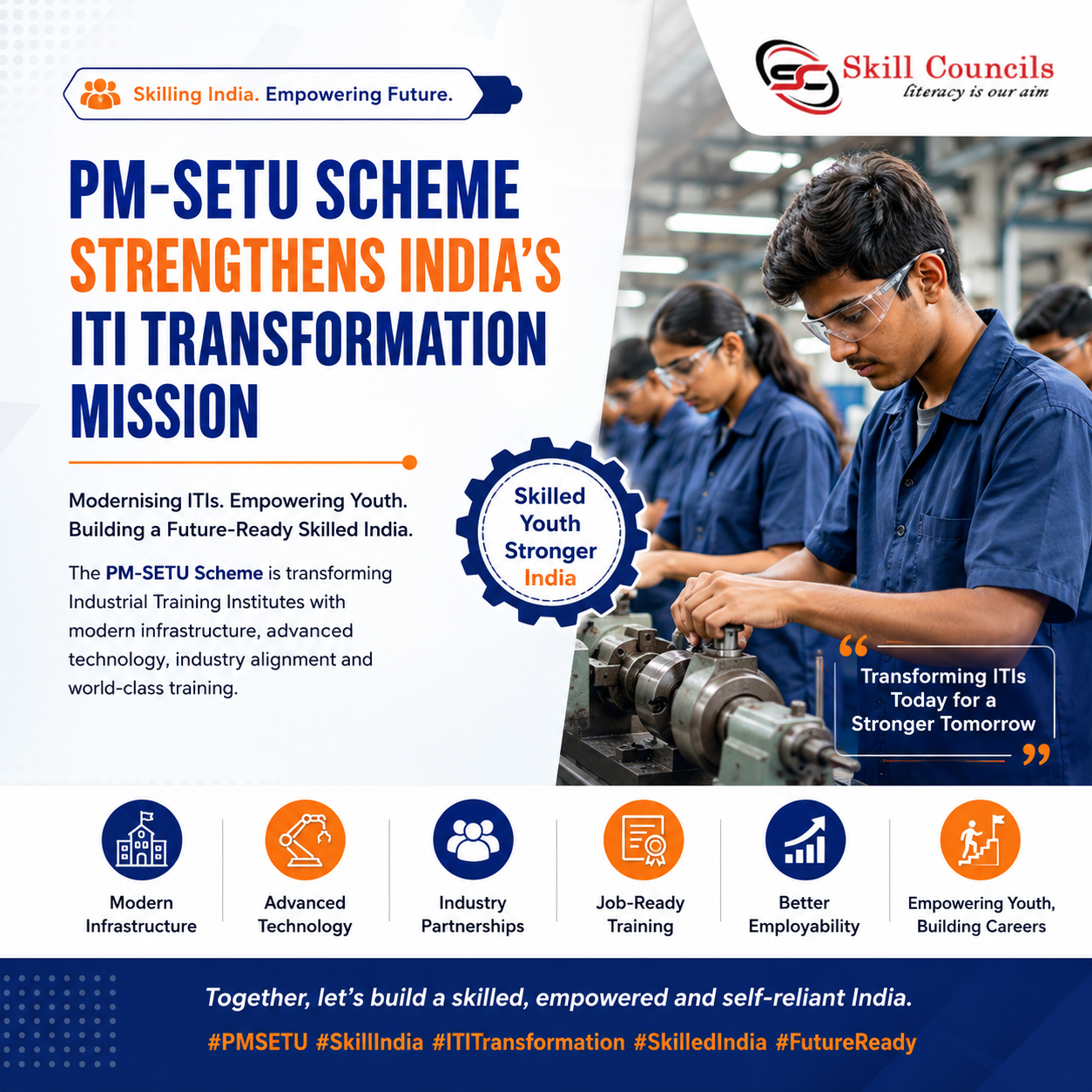
PM-SETU Scheme Strengthens India's ITI Transformation Mission to Boost Skill Development and Employability.
PM-SETU Scheme Strengthens India’s ITI Transformation Mission
Category: Skilling | Vocational Education | Employment
Published by SkillCouncils.com
Introduction
India's vision of becoming a global manufacturing and innovation powerhouse depends heavily on the availability of a skilled workforce. Recognising this need, the PM-SETU (Prime Minister's Scheme for Transforming Industrial Training Institutes) is accelerating the modernization of Industrial Training Institutes (ITIs) across the country. The initiative focuses on upgrading infrastructure, integrating advanced technologies, strengthening industry partnerships, and making vocational education more relevant to the evolving demands of the economy.
As India moves towards becoming a developed nation under the Viksit Bharat 2047 vision, the PM-SETU scheme is expected to play a transformative role in creating future-ready skilled professionals who can contribute to sectors such as manufacturing, electronics, renewable energy, artificial intelligence, electric mobility, construction, healthcare, logistics, and digital services.
Modernising India's Skill Ecosystem
Industrial Training Institutes have long been the backbone of India's vocational education system. However, changing industrial requirements demand modern facilities, updated curricula, and stronger industry participation.
The PM-SETU initiative addresses these challenges by supporting ITIs through:
- Modern laboratories and workshops
- Digital classrooms and smart learning infrastructure
- Industry-standard machinery and equipment
- Updated NSQF-aligned training programmes
- Faculty upskilling and capacity building
- Stronger apprenticeship opportunities
- Industry-led curriculum development
- Digital assessment and certification systems
These improvements aim to ensure that students graduate with skills that match current and future industry requirements.
Bridging the Skill Gap
India has one of the world's youngest populations, with millions entering the workforce every year. While employment opportunities continue to expand across emerging sectors, employers increasingly seek candidates with practical, job-ready skills.
The PM-SETU scheme aims to bridge this gap by making ITIs centres of excellence that provide:
- Practical and hands-on learning
- Industry-relevant technical education
- Better placement opportunities
- Entrepreneurship support
- Exposure to advanced manufacturing technologies
- Soft skills and employability training
This industry-oriented approach improves workforce readiness while reducing the mismatch between education and employment.
Supporting Industry 4.0
Modern industries are rapidly adopting technologies such as:
- Artificial Intelligence (AI)
- Robotics
- Internet of Things (IoT)
- Automation
- Smart Manufacturing
- Data Analytics
- Electric Vehicles (EV)
- Renewable Energy Systems
The PM-SETU scheme encourages ITIs to incorporate these emerging technologies into vocational education, preparing students for high-growth sectors and future careers.
Industry Collaboration at the Core
One of the strongest features of the PM-SETU initiative is its emphasis on industry participation.
Through collaboration with employers, Sector Skill Councils, MSMEs, large industries, and technology providers, ITIs can:
- Design demand-driven courses
- Offer apprenticeships
- Facilitate internships
- Improve placement outcomes
- Access modern equipment
- Align training with evolving job roles
Such partnerships ensure that training remains practical, current, and employment-focused.
Empowering Rural and Aspirational India
The modernization of ITIs extends beyond urban centres. By strengthening vocational institutions in rural, semi-urban, and aspirational districts, the scheme creates greater access to quality skill development for youth across India.
This inclusive approach helps:
- Increase employability among rural youth
- Support women in technical education
- Promote regional industrial growth
- Reduce migration through local employment opportunities
- Strengthen local economies
Impact on India's Economic Growth
A highly skilled workforce directly contributes to:
- Higher productivity
- Increased manufacturing competitiveness
- Greater innovation
- Stronger exports
- Employment generation
- Economic resilience
As India continues expanding initiatives like Make in India, Digital India, Startup India, Skill India, and Atmanirbhar Bharat, the modernization of ITIs through PM-SETU provides the skilled talent required to sustain long-term growth.
Opportunities for the Skill Development Ecosystem
The expansion of PM-SETU creates opportunities for:
- Training Providers
- Industrial Training Institutes
- Sector Skill Councils
- Assessment Agencies
- Technology Partners
- CSR Foundations
- Industry Associations
- Apprenticeship Providers
- Digital Learning Companies
- Equipment Manufacturers
Together, these stakeholders can contribute to building a world-class vocational education ecosystem.
Why This Matters
India's demographic dividend can only be fully realised when young people have access to high-quality, industry-relevant skills. The PM-SETU scheme is not merely upgrading institutions—it is transforming the way vocational education is delivered.
By modernising ITIs, strengthening industry partnerships, and preparing youth for future technologies, the initiative lays the foundation for sustainable employment, economic growth, and global competitiveness.
The transformation of India's ITIs represents more than infrastructure development; it is an investment in the nation's future workforce and a significant step toward making India a global hub for skilled talent.
View News Document
Recent Blogs


 in India Structure, Role, and Opportunities for Stakeholders.jpg)

.jpg)
.jpg)
