

Blog Details
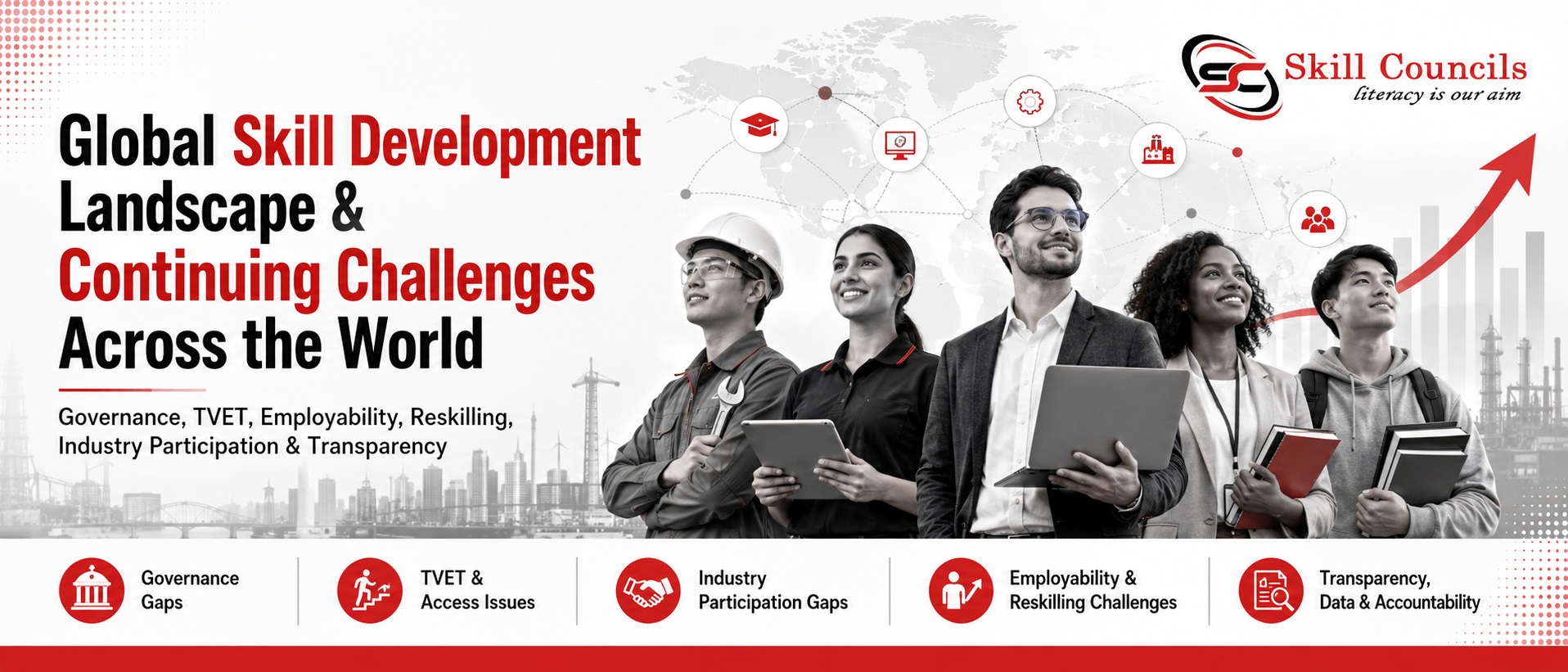
Global Skill Development Landscape: Opportunities, Governance Gaps and the Future of Work Challenge
Global Skill Development Landscape and Continuing Challenges
The global skill development landscape is undergoing a major transformation. Across developed, developing and emerging economies, governments, industries, education institutions and nonprofit organisations are under pressure to prepare people for a labour market shaped by artificial intelligence, automation, climate transition, migration, demographic change and global economic uncertainty.
Skill development is no longer only about vocational training or short-term employment courses. It has become a core part of national competitiveness, social inclusion, productivity growth and economic resilience. Countries that build strong, transparent and industry-aligned skilling systems will be better placed to manage the future of work. Countries that treat skilling as a policy slogan or contract-driven activity will continue to face unemployment, underemployment and productivity gaps.
The International Labour Organization’s Employment and Social Trends 2026 report projects global unemployment to remain at 4.9% in 2026, but also warns that the global jobs gap is expected to rise to nearly 408 million people. The ILO also reported that youth unemployment climbed to 12.4% in 2025, with around 260 million young people not in employment, education or training.
This shows that the world does not only need more jobs. It needs better pathways from education to employment, stronger vocational systems, credible certification, workplace-based learning and lifelong upskilling.
The Future of Work Is Already Reshaping Skills
Technology is changing the nature of work faster than many education and training systems can respond. The World Economic Forum’s Future of Jobs Report 2025 estimates that job disruption will affect 22% of jobs by 2030, with 170 million new roles expected to be created and 92 million displaced, resulting in a net gain of 78 million jobs.
This does not mean that work will disappear. It means that work will change. Routine tasks are being automated, digital tools are entering every sector, and workers are expected to combine technical skills with adaptability, problem-solving, communication, digital literacy and continuous learning.
The biggest risk is not technology itself. The real risk is that training systems, employers and governments fail to prepare workers for this transition.
The Global Skills Gap Is Also a Governance Gap
Most countries speak about the “skills gap,” but the problem is deeper. The world is also facing a governance gap in skill development.
In many countries, skill development programmes are launched with strong announcements, but weak execution. Training providers are selected without adequate quality checks. Courses are designed without real labour-market demand. Certification becomes more important than capability. Placement data is reported, but retention and wage growth are not tracked seriously.
This creates a dangerous gap between training numbers and real employability outcomes.
The World Bank notes that skills development is becoming central to workforce transformation because of automation, digitalisation, climate action and demographic shifts. It also highlights the need for education and workforce systems to become more personalised, accessible and continuous.
This means skill development can no longer be treated as a one-time training activity. It must become a lifelong system that supports school students, youth, workers, women, migrants, informal workers, entrepreneurs and mid-career professionals.
The Promoter-Driven Mindset in the Global Skilling Sector
Across many countries, especially in developing and emerging economies, skill development is often affected by a promoter-driven or contract-driven mindset. This is similar to what is sometimes called a “Lala mindset” in the Indian context, but globally it should be understood as a governance problem rather than a cultural label.
This mindset appears when organisations enter the skilling sector mainly to access public funds, donor grants, CSR projects, government contracts or development finance, rather than to build serious training institutions.
The common features include:
|
Governance Problem
|
Impact on Skill Development
|
|
Contract-first approach
|
Training becomes project delivery, not workforce development
|
|
Weak institutional governance
|
Nonprofits and training bodies operate like private businesses
|
|
Poor transparency
|
Funding, procurement and outcomes are not openly disclosed
|
|
Policy manipulation
|
Access to officials becomes more valuable than delivery quality
|
|
Short-term revenue focus
|
Long-term learner support and employer partnerships are ignored
|
|
Certificate-driven model
|
Training completion is reported, but job readiness remains weak
|
|
Low accountability
|
Poor performers continue to receive projects due to networks
|
This is one of the biggest threats to the credibility of skill development worldwide. A training system cannot succeed if it rewards paperwork more than performance.
Nonprofit Organisations Must Not Operate Like Private Shops
Globally, many nonprofit organisations play an important role in skilling, employment, livelihood development, entrepreneurship and inclusion. They work with youth, women, refugees, informal workers, persons with disabilities and disadvantaged communities.
However, the nonprofit label alone does not guarantee public interest. In many places, nonprofit institutions are controlled by a small group of promoters, families or politically connected networks. Boards may exist only for compliance. Financial disclosures may be weak. Decisions may be centralised. Social impact may be claimed but not independently verified.
This is a serious issue because skill development often involves public money, donor funding, CSR support or multilateral development finance. Such funds must be handled with transparency and accountability.
A credible nonprofit skilling organisation should have:
- independent board oversight;
- audited financial statements;
- transparent procurement;
- conflict-of-interest policies;
- public impact reports;
- grievance redressal for learners;
- verified placement and retention data;
- strong employer partnerships;
- learner protection standards.
Without these systems, nonprofit organisations can become private business vehicles operating under a social development identity.
TVET Still Struggles With Image, Access and Industry Linkage
Technical and Vocational Education and Training, or TVET, is essential for global workforce development. It supports employability, entrepreneurship, productivity and social mobility. Yet in many countries, TVET is still seen as a second-choice pathway compared to university education.
This perception damages the sector. Young people often enter vocational training only when academic routes fail. Parents may not see TVET as prestigious. Employers may complain about skill gaps but may not invest enough in apprenticeships or workplace training.
WorldSkills has highlighted that TVET continues to face challenges around prestige, attractiveness, awareness of labour-market demand and recognition of vocational pathways.
To change this, countries must reposition vocational education as a high-value career pathway. Germany, Switzerland, Singapore and other strong skills economies show that vocational training can be respected when it is linked to industry, wages, progression and national productivity.
Underfunding and Inequality Remain Major Global Barriers
Skill development cannot succeed without investment in education, training infrastructure, trainers, digital access and industry equipment. But education and training systems are facing pressure in many low- and middle-income countries.
UNESCO warned in 2025 that international aid to education could fall by more than a quarter between 2023 and 2027, while 272 million children and young people were out of school.
This matters because the global skills crisis begins much before vocational training. If children and youth do not receive quality basic education, digital literacy, numeracy, communication skills and career guidance, later-stage skill training becomes less effective.
The global skilling agenda must therefore connect school education, vocational education, higher education, apprenticeships and lifelong learning.
Industry Participation Is Still Too Limited
One of the biggest weaknesses in global skill development is the lack of meaningful industry participation. Employers often demand job-ready workers but do not contribute enough to curriculum design, practical training, apprenticeships, equipment, trainer development or assessment.
This creates a mismatch between what training institutions teach and what workplaces require.
Industry must move from being a beneficiary of skilling to becoming a co-owner of skilling. That means:
- designing job roles with training institutions;
- offering apprenticeships and internships;
- providing workplace exposure;
- supporting trainer upskilling;
- validating curriculum;
- participating in assessment;
- sharing labour-market demand data;
- hiring based on demonstrated skills, not only degrees.
Without industry participation, skill development remains classroom-heavy and employment-light.
The Certificate Economy Is a Global Problem
Many countries have created large certification systems. While certification is important, it should not become the final goal.
A certificate should prove capability. It should not become a replacement for capability.
The certificate economy becomes dangerous when training providers focus on enrolment, attendance, assessment and certificate issuance without ensuring that learners are actually employable. This creates a false success story. Governments report numbers. Providers claim achievement. But learners remain unemployed or underpaid.
A strong global skill development system must track:
|
Success Indicator
|
Why It Matters
|
|
Training completion
|
Shows basic programme delivery
|
|
Certification
|
Confirms assessment, if credible
|
|
Job placement
|
Shows labour-market connection
|
|
Retention after 3–6 months
|
Shows real employment sustainability
|
|
Wage growth
|
Shows economic impact
|
|
Employer satisfaction
|
Shows workplace readiness
|
|
Career progression
|
Shows long-term skill value
|
|
Entrepreneurship outcomes
|
Shows livelihood creation
|
The future of skill development must move from “trained and certified” to “skilled, employed, retained and progressing.”
AI, Green Jobs and Digital Transformation Need New Training Models
The next generation of skill development will be shaped by artificial intelligence, robotics, cybersecurity, healthcare technology, clean energy, electric mobility, climate adaptation, advanced manufacturing, logistics and platform-based services.
Traditional training models are not enough for these sectors. A short classroom course cannot create a high-quality AI technician, EV mechanic, solar installer, robotics operator, healthcare assistant or cybersecurity associate unless learners get practical exposure, updated tools and workplace-linked training.
The future skills agenda requires:
- modern laboratories;
- digital learning platforms;
- simulation-based training;
- industry-certified trainers;
- modular courses;
- micro-credentials;
- apprenticeship models;
- international skill standards;
- recognition of prior learning;
- continuous reskilling for working adults.
The global workforce cannot be prepared for future jobs using outdated training infrastructure.
Corruption, Bureaucracy and Policy Capture Must Be Addressed
A major challenge in many skill development ecosystems is the influence of bureaucracy, corruption and policy capture. When project approvals, funding releases, training centre allocation or certification processes depend on informal networks, the quality of the sector declines.
This discourages genuine institutions and rewards those who understand manipulation better than training.
Skill development must be protected from:
- politically connected project allocation;
- inflated training numbers;
- fake attendance;
- poor-quality centres;
- manipulated placement reporting;
- delayed payments;
- weak audits;
- non-transparent procurement;
- conflict of interest in assessments.
If corruption enters the skilling ecosystem, the biggest loss is not only financial. The biggest loss is the trust of youth, employers and society.
What the World Needs Now
The global skill development sector needs a new compact between governments, employers, education institutions, nonprofits and workers.
1. Outcome-Based Funding
Funding should be linked to verified learning, employment, retention, wage improvement and employer satisfaction, not only enrolment and certification.
2. Stronger Governance
Training providers and nonprofits must follow transparent governance standards, especially when using public, donor or CSR funding.
3. Industry-Led Skilling
Employers must participate directly in curriculum, training, apprenticeship and hiring.
4. Lifelong Learning Systems
Workers must be able to reskill throughout their careers through flexible, affordable and recognised learning pathways.
5. Digital and Green Skills Integration
Every country must prepare workers for AI, automation, green jobs, climate resilience and digital work.
6. Better Labour-Market Data
Training decisions must be based on real demand, not assumptions or political announcements.
7. Inclusion First
Women, youth, migrants, refugees, rural communities, informal workers and persons with disabilities must be included in mainstream skilling systems.
Conclusion: From Training Projects to Workforce Transformation
The global skill development challenge is not only about creating more training centres or issuing more certificates. It is about building a trusted workforce development system that connects education, industry, technology, livelihoods and social mobility.
The world already knows that the future of work is changing. The question is whether skill development systems will change fast enough.
Governments must stop treating skilling as a scheme-based activity. Businesses must stop demanding skilled workers without investing in them. Nonprofits must stop operating like private contract shops. Training providers must stop chasing numbers and start building capability. International organisations and donors must support systems that are transparent, accountable and locally relevant.
The future belongs to countries and institutions that can convert training into employability, employability into productivity, and productivity into inclusive economic growth.
Skill development is no longer a welfare activity. It is a global economic necessity.
Global skill development, future of work, TVET, workforce development, employability, vocational training, skills gap, youth unemployment, reskilling, upskilling, industry participation

Recent Blogs



 in India Structure, Role, and Opportunities for Stakeholders.jpg)

.jpg)

.jpg)
