

Blog Details
Skill Development in India: Growth, Governance Gaps and the Mindset Challenge
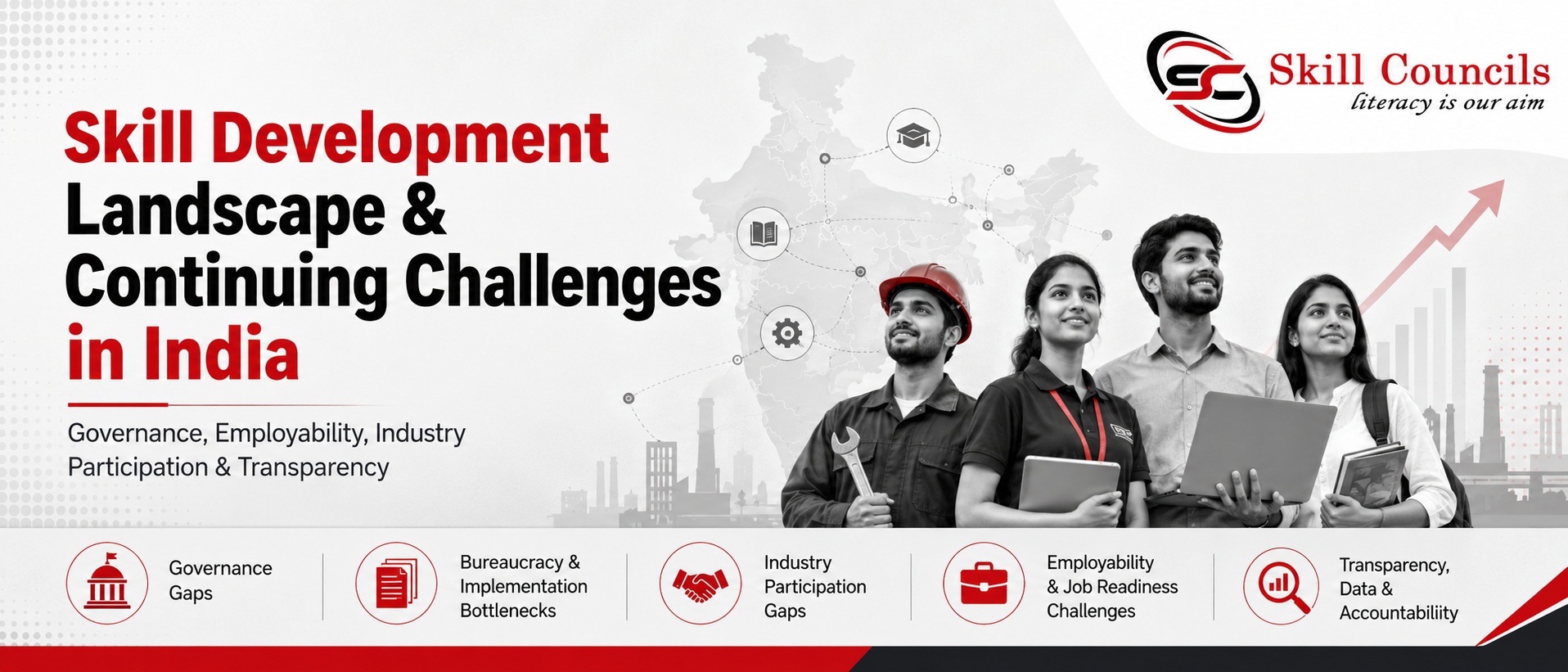
Skill development landscape and continually challenges in India.
Indian businessman mindset is a Lala mindset for the business; they don’t able to run the non-profit originations and business.
they only believe to manipulate the policies, advantage for corruption and Government Department hierarchy.
they only believe to manipulate the policies, advantage for corruption and Government Department hierarchy.
Skill Development Landscape and Continuing Challenges in India
India’s skill development ecosystem is at a critical stage. On one side, the country has a young workforce, expanding digital infrastructure, growing demand for future-ready skills, and a strong policy push through Skill India, PMKVY, apprenticeships, ITI modernisation and state-level skilling missions. On the other side, the sector continues to face serious challenges: weak placement outcomes, poor training quality, fragmented implementation, low industry ownership, and a governance culture where some organisations treat skill development as a tender-driven business instead of a long-term nation-building mission.
The Government has increased its focus on skilling. For FY 2026–27, the Budget Estimate allocation for schemes under the Ministry of Skill Development and Entrepreneurship rose to ₹9,540.50 crore from ₹5,749.90 crore in FY 2025–26, mainly due to the PM-SETU scheme for upgrading ITIs. The same official update says PM-SETU aims to upgrade 1,000 government ITIs through a hub-and-spoke model and build modern laboratories, smart classrooms, digital content and industry-aligned courses.
However, funding and schemes alone cannot solve India’s skill development crisis. The real question is whether training is leading to decent jobs, sustainable livelihoods, higher productivity and stronger entrepreneurship.
India’s Skilling Paradox: Big Numbers, Weak Conversion
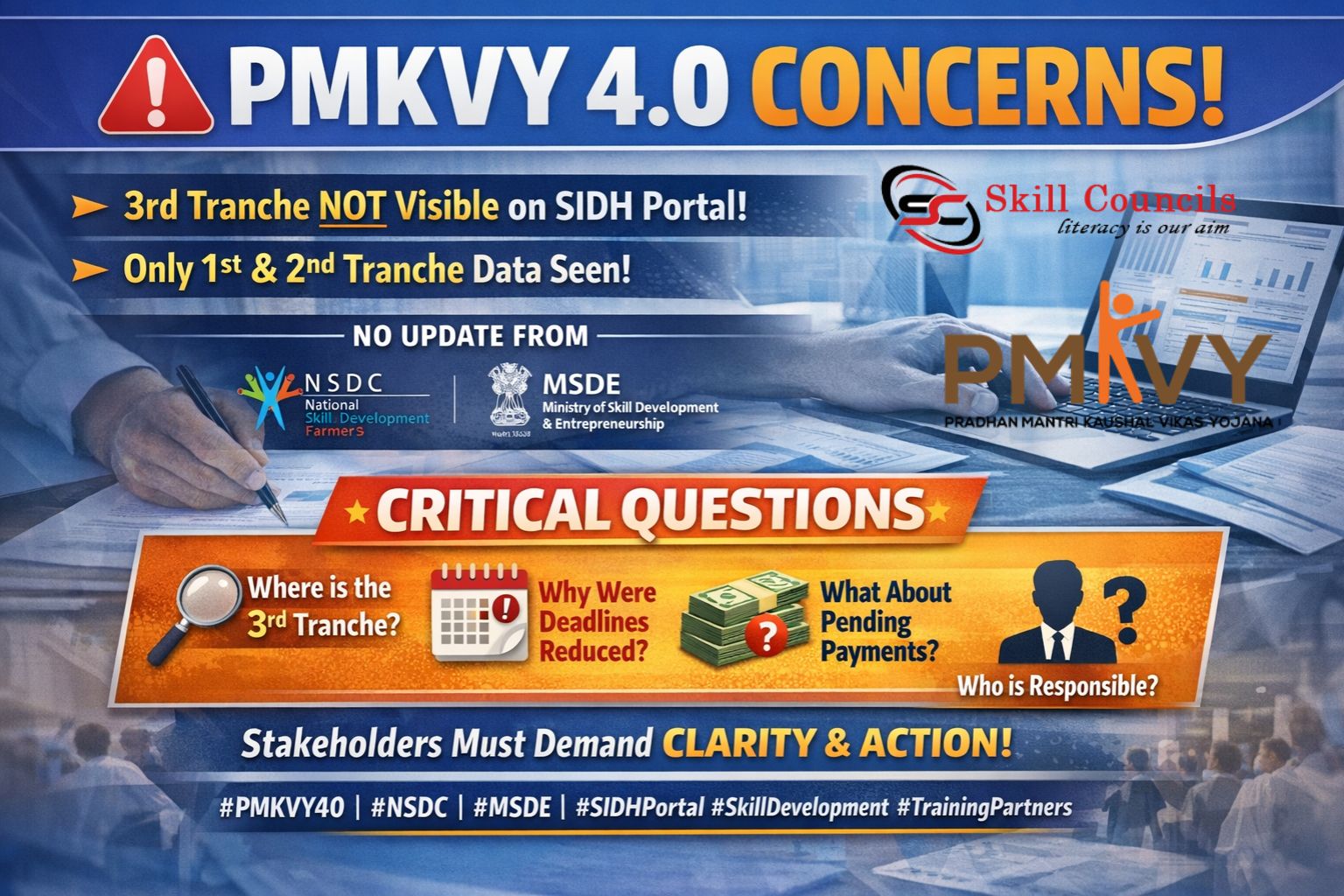
India has built one of the world’s largest skill development architectures. Under PMKVY 4.0, 27.08 lakh candidates had been trained across 38 sectors, 36 states and 732 districts as of 7 December 2025. The Ministry also reported 77 customised courses and 102 future-skill job roles in areas such as AI, Industry 4.0, green jobs and digital services.
Despite this scale, India still faces a major vocational training gap. According to PLFS Annual Report 2025 highlights released by MoSPI, only 4.2% of persons aged 15–59 reported receiving or currently receiving formal vocational or technical training. Among youth aged 15–29, the share was only 5.0%. The same report estimated youth unemployment at 9.9% in 2025 and found that 25.0% of persons aged 15–29 were not in employment, education or training.
This is the central contradiction: India has a large skilling framework, but formal vocational training still reaches only a small section of the working-age population. The country is producing certificates, but not always confidence, capability or employability.
The Real Challenge Is Not Only Skill Gap, But Trust Gap
The skill development sector often discusses “skill gap” as if the problem is only a shortage of trained workers. But India also has a trust gap.
Employers often do not trust the quality of short-term training certificates. Candidates often do not trust that training will result in a job. Training partners often depend on government schemes instead of building direct employer-led models. Government departments often measure enrolment, training completion and certification more easily than long-term employment, wage growth or productivity.
The result is a system where many stakeholders are active, but accountability is scattered.
A CAG audit summary published by PRS noted that PMKVY’s first three phases had a combined target of training and certifying around 1.32 crore candidates. In the short-term training and special project components, 56 lakh candidates were certified and 41% were placed. The audit also observed that training was not fully aligned with skill-gap requirements and that job-role selection without adequate market-demand analysis was one reason for low placements.
This finding is important because it confirms what many sector professionals already know: training without demand mapping becomes a compliance exercise.
The “Lala Mindset” Problem: A Governance Issue, Not a Community Label
In public discussion, the phrase “Lala mindset” is sometimes used to describe a narrow, promoter-controlled business approach. For this article, the term should not be read as a community or identity label. It should be understood as a shorthand for a governance pattern: excessive owner control, low transparency, relationship-driven decision-making, short-term cash extraction and resistance to professional systems.
This mindset becomes especially damaging when it enters the nonprofit and skill development space.
A business can be profit-oriented. But a nonprofit organisation, training society, educational trust or skill development institution must be mission-oriented. It must work with transparency, independent governance, ethical accounting, learner-first delivery and measurable social impact. When a promoter-driven mindset captures nonprofit institutions, the organisation may start behaving like a private contract shop while wearing the mask of social service.
This is where the sector becomes vulnerable to manipulation.
How Policy Manipulation Weakens Skill Development
India does not lack policies. In fact, the skilling sector has policies, schemes, qualification frameworks, portals, councils, assessments, monitoring mechanisms and digital dashboards. The problem is that some players learn how to manipulate the system rather than improve outcomes.
Common patterns include:
|
Problem Area
|
How It Affects Skill Development
|
|
Tender-driven approach
|
Organisations chase projects, not outcomes
|
|
Inflated enrolment
|
Numbers look good, but learner impact remains weak
|
|
Weak placement tracking
|
Short-term joining is shown as success, while retention is ignored
|
|
Poor trainer quality
|
Candidates receive certificates without real job readiness
|
|
Policy networking
|
Access to officials becomes more important than delivery capability
|
|
Compliance-first reporting
|
Documentation becomes stronger than actual training
|
|
Nonprofit misuse
|
Trusts and societies are used as vehicles for contracts instead of public service
|
This is not an argument against government schemes. Government support is essential for skilling at scale. But when implementation is captured by politically connected, compliance-focused or tender-dependent operators, the spirit of skill development gets diluted.
Corruption and Hierarchy: The Silent Barriers
One of the most uncomfortable challenges in India’s skill development ecosystem is the influence of hierarchy and informal power networks. Many genuine training providers, startups, community institutions and grassroots organisations struggle not because they lack capability, but because they lack access.
In some cases, the ecosystem rewards those who understand paperwork, lobbying and departmental relationships better than those who understand learners, employers and training quality. This creates a dangerous imbalance.
When hierarchy dominates, decision-making slows down. When corruption enters, quality exits. When policy is manipulated, the honest provider loses confidence. When payments are delayed or approvals become relationship-based, the sector stops attracting serious professionals.
Skill development cannot become a high-impact national mission if it is treated as a file movement exercise.
Nonprofits Cannot Be Run Like Private Family Shops
A major concern is the way some nonprofit organisations are managed. Many trusts, societies and Section 8 companies are created with social objectives, but their internal culture remains highly centralised. Boards may exist only on paper. Independent oversight may be weak. Financial disclosures may be limited. Decisions may be taken by one promoter or one family.
This is harmful for three reasons.
First, public money and CSR money require public accountability. Second, learners from vulnerable communities depend on these institutions for livelihood opportunities. Third, skill development is not a one-time transaction; it requires counselling, mobilisation, training, assessment, placement, retention support and employer engagement.
A nonprofit that runs like a private shop cannot deliver this mission with credibility.
The sector needs professional boards, transparent procurement, audited impact reports, grievance redressal, trainer development, placement verification and conflict-of-interest disclosures.
Industry Participation Is Still Too Weak
The future of skilling cannot be built by government departments and training partners alone. Employers must become co-creators of the system.
Apprenticeship is one of the strongest bridges between classroom learning and workplace readiness. NSDC describes apprenticeship as a model where individuals receive classroom learning followed by on-the-job practical training. It also notes that establishments with more than three employees are mandated under law to engage apprentices.
But the apprenticeship mindset has still not become mainstream across Indian businesses. Many employers want job-ready candidates but do not want to invest in training. Many small and medium enterprises see apprentices as compliance or cheap labour rather than future talent. This weakens the education-to-employment pipeline.
If industry does not invest time, machinery, mentors and workplace exposure, India’s skilling system will remain incomplete.
The Certificate Economy Must End
One of the biggest risks in Indian skill development is the rise of a “certificate economy.” In this model, success is measured by the number of people trained, assessed and certified. But a certificate is not a livelihood.
A meaningful skill programme should answer five questions:
- Did the candidate learn a real, marketable skill?
- Did the training match local or sectoral demand?
- Did the candidate get employment, self-employment or income improvement?
- Did the candidate remain employed after three to six months?
- Did the employer find the candidate productive?
Without these answers, skilling becomes a data-reporting exercise.
The World Bank notes that under the Skill India Mission Operation project, almost 6 million young people were trained, 34% of them women, and 40% of all trainees were wage-employed within six months. This shows that outcome tracking is possible, but it must become more rigorous, transparent and widely adopted across schemes.
Future Skills Need Future Governance
India is now moving toward AI, drones, semiconductors, green hydrogen, EVs, robotics, logistics, healthcare, cybersecurity and global mobility. PMKVY 4.0 already includes new-age and future-skill job roles aligned with Industry 4.0, including AI/ML, drone technology and green hydrogen.
But future skills cannot be delivered with outdated governance. A centre cannot teach AI with only PowerPoint slides. A drone training programme cannot succeed without equipment, simulators, safety protocols and field practice. A green hydrogen technician course cannot be meaningful without industry labs, updated trainers and employer linkages.
The future-skills agenda requires:
- qualified trainers, not just certified trainers;
- industry-grade infrastructure, not symbolic labs;
- live projects, not only theory;
- digital records, not manipulated attendance;
- employer-led assessment, not only third-party formalities;
- wage-linked outcomes, not only placement letters.
What Needs to Change
India’s skill development sector needs reform at four levels.
1. Governance Reform
Training partners, nonprofits and skill institutions must adopt professional governance. Independent boards, audited financials, public impact reports, transparent procurement and conflict-of-interest policies should become mandatory for publicly funded projects.
2. Outcome-Based Funding
Payments should be linked not only to enrolment and certification but also to verified placement, retention, wage improvement, apprenticeship conversion and self-employment outcomes.
3. Employer Ownership
Industry should not remain a guest in the skilling ecosystem. Employers must help design curriculum, provide trainers, offer apprenticeships, assess candidates and commit to hiring.
4. Local Skill Mapping
National schemes must be supported by district-level and cluster-level demand mapping. A course should not be launched merely because it is available on a list. It should be launched because employers, markets or self-employment opportunities exist.
The Way Forward: From Scheme Mindset to Nation-Building Mindset
India’s skill development mission cannot succeed through schemes alone. It needs a mindset shift.
Training providers must stop thinking only about tenders. Businesses must stop expecting fully trained workers without investing in training. Nonprofits must stop operating like family-controlled private shops. Government departments must move from file-based monitoring to outcome-based accountability. Industry must move from complaint to participation.
The country does not need more certificates without jobs. It needs skilled workers with dignity, income and mobility. It needs training institutions that are trusted by both youth and employers. It needs nonprofit organisations that are genuinely mission-driven. It needs business leaders who understand that skill development is not charity, not contract management and not policy manipulation — it is the foundation of India’s economic future.
India has the demographic strength. It has policy support. It has budgetary commitment. It has digital infrastructure. What it now needs is integrity in implementation.
The next phase of Skill India must be built not only on training numbers, but on trust, transparency, professionalism and real employment outcomes.
Skill Development in India, Skill India Mission, vocational training, PMKVY, employability, apprenticeship, nonprofit governance, training partners, India skill gap

Recent Blogs



 in India Structure, Role, and Opportunities for Stakeholders.jpg)

.jpg)
.jpg)
