

News Details
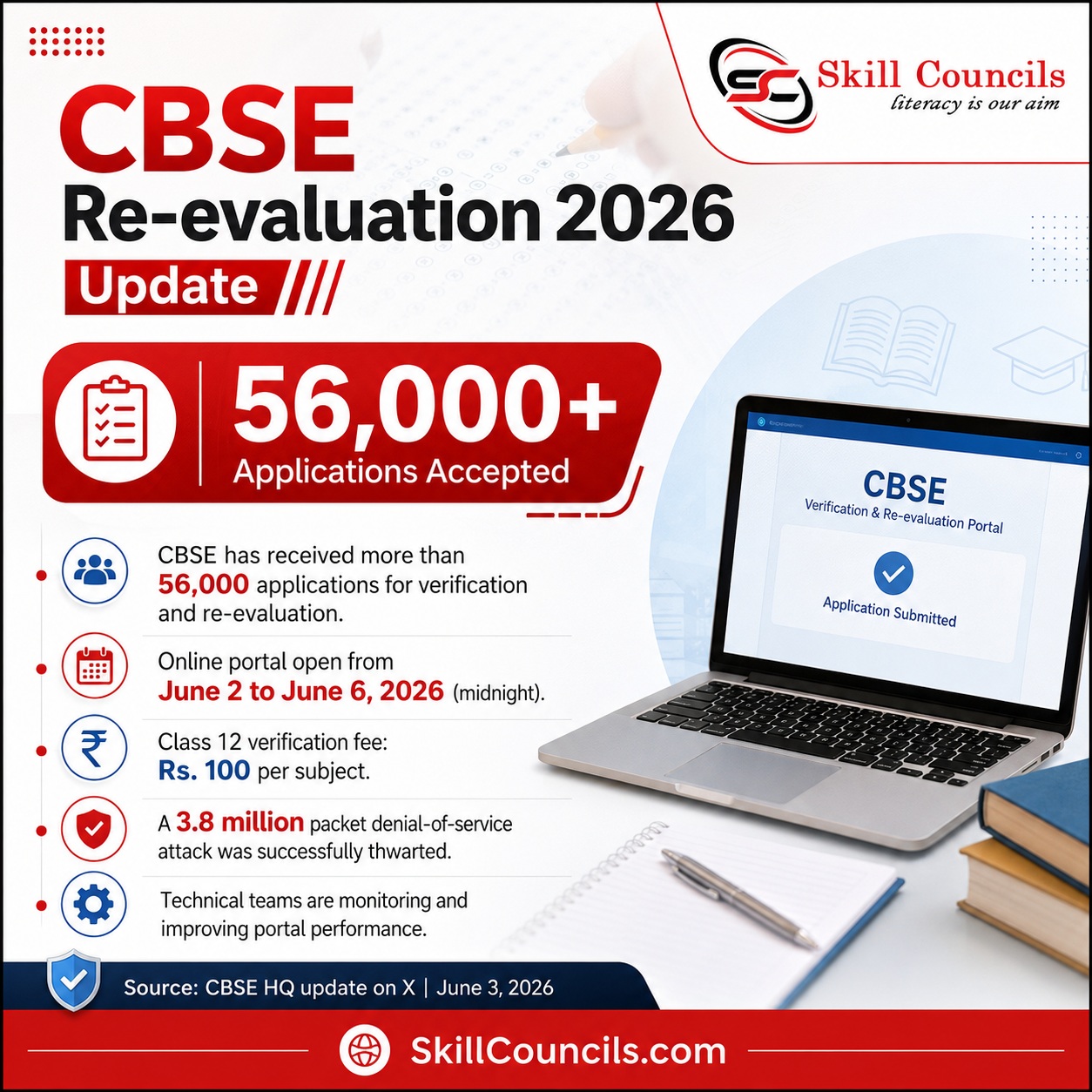
CBSE Re-evaluation 2026: Verification & Re-evaluation Portal Accepts 56,000+ Applications, Fee, Eligibility, Dates and Process Explained
CBSE Re-evaluation 2026 Update: 56,000+ Applications Accepted, Portal Secured Against Cyberattack
CBSE Re-evaluation 2026 update: More than 56,000 applications accepted for verification and re-evaluation. Check launch date, eligibility, fees, process, authorities, timeline, impact and key rules for students.
News Summary
The Central Board of Secondary Education (CBSE) has reported a strong student response to its Class 12 post-result verification and re-evaluation facility for 2026. According to the board’s update, more than 56,000 applications were accepted on the CBSE verification and re-evaluation portal as of June 3, 2026, 9:30 PM.
The online portal became operational for verification of issues observed and re-evaluation of questions from June 2, 2026, with the application window notified up to June 6, 2026, midnight. During this period, CBSE also confirmed that its technical teams successfully thwarted a major 3.8 million-packet denial-of-service attack on the portal.
The development is significant because CBSE introduced On-Screen Marking (OSM) for Class XII answer books in the 2026 board examinations. The post-result facility is intended to provide students a structured mechanism to review scanned answer books, raise specific issues, and seek re-evaluation where required.
What is CBSE Re-evaluation 2026?
CBSE Re-evaluation 2026 is a post-result academic review facility provided to eligible Class XII students after the declaration of board examination results. It allows students to review their evaluated answer books and apply for correction or re-evaluation under prescribed rules.
The 2026 process is linked to CBSE’s digital evaluation reforms, especially the introduction of On-Screen Marking for Class XII answer books. Under this system, scanned answer scripts are evaluated digitally, with the aim of improving accuracy, transparency, confidentiality and processing efficiency.
Launch Date and Timeline
|
Activity |
Date / Timeline |
|
Introduction of On-Screen Marking for Class XII exams |
2026 Board Examination cycle |
|
Notice for post-result declaration facilities |
May 15, 2026 |
|
Fee reduction notice |
May 17, 2026 |
|
Scanned copy of evaluated answer book window |
May 19 to May 22, 2026, later extended |
|
Verification of issues observed and re-evaluation portal operational |
June 2, 2026 |
|
Revised application window for verification/re-evaluation |
June 2 to June 6, 2026, midnight |
|
Applications accepted as per CBSE update |
56,000+ by June 3, 2026, 9:30 PM |
Authorities Involved
|
Authority / Institution |
Role |
|
Central Board of Secondary Education |
Nodal authority for board examinations, result processing, post-result services and re-evaluation |
|
Ministry of Education, Government of India |
Administrative oversight, as CBSE is an autonomous organisation under the Ministry |
|
Controller of Examinations, CBSE |
Issuance of official notices, operational guidelines and process instructions |
|
CBSE Regional Offices |
Administrative support and coordination with schools/students |
|
CBSE Technical Teams |
Portal operation, monitoring, cybersecurity response and performance refinement |
|
Government technical agencies / digital support teams |
Technical supervision and portal management support |
Key Functions of the CBSE Post-Result Facility
- Providing Scanned Answer Books
Students can obtain scanned copies of evaluated answer books for selected subjects. - Verification of Issues Observed
Students may report issues such as missing pages, blurred pages, missing supplementary sheets, answer book mismatch, missing graph/map sheets or evaluation against a different set of marking scheme. - Re-evaluation of Answers
Students can request re-evaluation of one or more specific questions after reviewing the scanned answer book and official marking scheme. - Digital Grievance Redressal
The process provides an online route to address genuine concerns related to evaluation. - Transparent Student Interface
Students can apply through the portal, pay fees online, track status and receive communication on the decision. - Cyber-secure Examination Services
CBSE’s response to the attempted denial-of-service attack shows the need for secure digital infrastructure in large-scale education systems.
Eligibility of Beneficiaries
Eligible Beneficiaries
The primary beneficiaries are Class XII students of CBSE Board Examination 2026 who are seeking review of their evaluated answer books after declaration of results.
Students must follow the prescribed sequence:
- First apply for the scanned copy of the evaluated answer book.
- Review the answer book and marking scheme.
- Apply for verification of issues observed and/or re-evaluation of specific answers, if required.
Important Eligibility Rule
Only candidates who have applied for and obtained the scanned copy of their evaluated answer book are eligible to apply for the next stage of verification or re-evaluation.
Employer Eligibility
There is no employer eligibility under this facility. This is not an employment-linked scheme, apprenticeship scheme, recruitment programme, training grant or employer subsidy. Employers, training partners and institutions may benefit indirectly because corrected academic records can support admission, recruitment, counselling and documentation processes, but employers are not direct applicants or beneficiaries.
Fee Structure
CBSE reduced the applicable fees to make the post-result facility more student-friendly.
|
Facility |
Revised Fee |
|
Scanned copy of evaluated answer book |
₹100 per subject |
|
Verification of issues observed |
₹100 per answer book |
|
Re-evaluation |
₹25 per question |
CBSE has also stated that the fee will be refunded in cases where marks increase after re-evaluation.
Application Process
Students must apply only through the official online facility. Offline applications are not accepted.
Step-by-Step Process
- Visit the CBSE post-result services portal.
- Login using required credentials such as roll number and admit card details.
- Select the relevant service from the dashboard.
- Choose verification of issues observed and/or re-evaluation of marks.
- Select subject and question details carefully.
- Provide reasoning where re-evaluation is requested.
- Pay the prescribed fee online.
- Submit the application and save confirmation details.
- Track the application status through the portal.
Key Rules for Students
- Applications must be submitted online only.
- No application is accepted after the notified deadline.
- Offline applications are not accepted.
- Only one application for each stage is permitted.
- Students must select all issues/questions carefully before final submission.
- Marks may increase or decrease after re-evaluation.
- The revised result is final and binding.
- If marks change, the student must surrender the original mark statement-cum-certificate before receiving a revised certificate.
- Re-evaluation or grievance redressal cannot be requested under RTI; however, answer book copies may be available under RTI provisions separately.
Cybersecurity Update: Why It Matters
CBSE stated that its portal successfully withstood a 3.8 million-packet denial-of-service attack during the application period. This is an important development because education boards are increasingly dependent on digital systems for high-stakes examination processes.
The incident highlights three key policy concerns:
- Digital examination infrastructure must be cyber-resilient.
- Student-facing portals must remain accessible during peak traffic.
- Data security and system monitoring are now critical parts of examination governance.
For a board handling lakhs of students, secure digital grievance redressal is no longer optional. It is a core requirement for trust, transparency and accountability.
Impact Analysis
Impact on Students
The facility provides students a formal route to raise evaluation-related concerns. It is particularly important for students applying to higher education institutions, competitive programmes, scholarships and other academic pathways where even small changes in marks can matter.
Impact on Schools
CBSE-affiliated schools must communicate timelines, fees, eligibility and rules to students and parents. Schools also need to support awareness while ensuring students use official channels only.
Impact on Digital Governance
The 2026 process reflects a shift towards technology-driven examination management. The introduction of On-Screen Marking and online post-result services can reduce manual errors and improve process traceability.
Impact on Higher Education and Admissions
Updated marks after re-evaluation may influence merit lists, admission eligibility, subject cut-offs and documentation. Universities and admission authorities may need to account for revised mark sheets where applicable.
Impact on Policy and R&D
The CBSE 2026 case provides useful learning for assessment reforms, digital evaluation, cybersecurity planning and grievance-redressal design. Future examination systems may increasingly combine digital marking, audit trails, student-facing review windows and automated status tracking.
Fund Allocation and Utilisation
This facility is not a separately announced government scheme with a dedicated budget head. It is a CBSE administrative and examination-related post-result service. Therefore, scheme-wise allocation and utilisation for the last five financial years are not separately available in public notices.
|
Financial Year |
Scheme-Specific Allocation |
Scheme-Specific Utilisation |
Status |
|
2021-22 |
Not separately published |
Not separately published |
Not applicable as a standalone scheme |
|
2022-23 |
Not separately published |
Not separately published |
Covered under CBSE examination and administrative systems |
|
2023-24 |
Not separately published |
Not separately published |
CBSE publishes board-level financial statements, not separate re-evaluation scheme data |
|
2024-25 |
Not separately published |
Not separately published |
No dedicated public budget head identified for this facility |
|
2025-26 |
Not separately published |
Not separately published |
Process supported through CBSE examination infrastructure and processing charges |
Financial Note for Readers
CBSE does publish annual reports, annual accounts and consolidated budget estimates. However, no separate public allocation has been identified specifically for “CBSE Re-evaluation 2026” as an independent scheme. The process is funded and administered as part of CBSE’s examination ecosystem and through prescribed processing charges paid by applicants.
Policy Research Perspective
CBSE’s 2026 post-result process indicates a broader transformation in India’s school examination governance. The move from physical evaluation to On-Screen Marking is intended to reduce human handling, improve secrecy, avoid totalling and uploading errors, and create a scalable digital framework.
However, the heavy application volume and cyberattack attempts show that digital reforms must be accompanied by strong technical preparedness, transparent communication and clear grievance-redressal rules.
For policymakers, the CBSE 2026 update raises important questions:
- How can digital evaluation systems be independently audited?
- What minimum cybersecurity standards should apply to education portals?
- Should students receive more structured guidance on reading scanned answer books and marking schemes?
- Can re-evaluation timelines be aligned with college admission calendars?
- How can boards ensure that economically weaker students are not excluded due to processing fees?
Conclusion
The CBSE Re-evaluation 2026 update is an important development for students, schools and education administrators. With more than 56,000 applications accepted in the early phase and a major cyberattack successfully thwarted, the update reflects both the scale and sensitivity of digital examination services.
While this is not a government welfare scheme, it is a major public education service linked to transparency, fairness and student confidence in board examination outcomes. Students are advised to use only official CBSE platforms, follow deadlines carefully and submit applications after reviewing the rules and marking scheme.
FAQs
What is CBSE Re-evaluation 2026?
CBSE Re-evaluation 2026 is a post-result facility that allows eligible Class XII students to seek verification of issues observed and re-evaluation of specific answers after obtaining scanned copies of evaluated answer books.
Who can apply for CBSE re-evaluation?
Only students who have obtained the scanned copy of their evaluated answer book can apply for verification or re-evaluation.
What is the CBSE re-evaluation fee in 2026?
The revised fee is ₹25 per question for re-evaluation. Verification of issues observed costs ₹100 per answer book.
Is offline application allowed?
No. CBSE accepts applications only through the online portal.
Can marks decrease after re-evaluation?
Yes. Marks may increase or decrease, and the revised result is final and binding.
Is this a government scheme?
No. It is a CBSE post-result declaration facility, not a government welfare or funding scheme.
Are employers eligible under this facility?
No. Employers are not direct beneficiaries. The facility is meant for CBSE Class XII students.
Why is this update important?
It shows rising student demand for transparent evaluation review and highlights the importance of secure digital education infrastructure.
CBSE Re-evaluation 2026, CBSE verification 2026, CBSE Class 12 re-evaluation, CBSE post-result services, CBSE answer sheet verification, CBSE OSM 2026, CBSE rechecking fee 2026, CBSE portal update
View News Document
Recent Blogs


 in India Structure, Role, and Opportunities for Stakeholders.jpg)


.jpg)
.jpg)
