

News Details
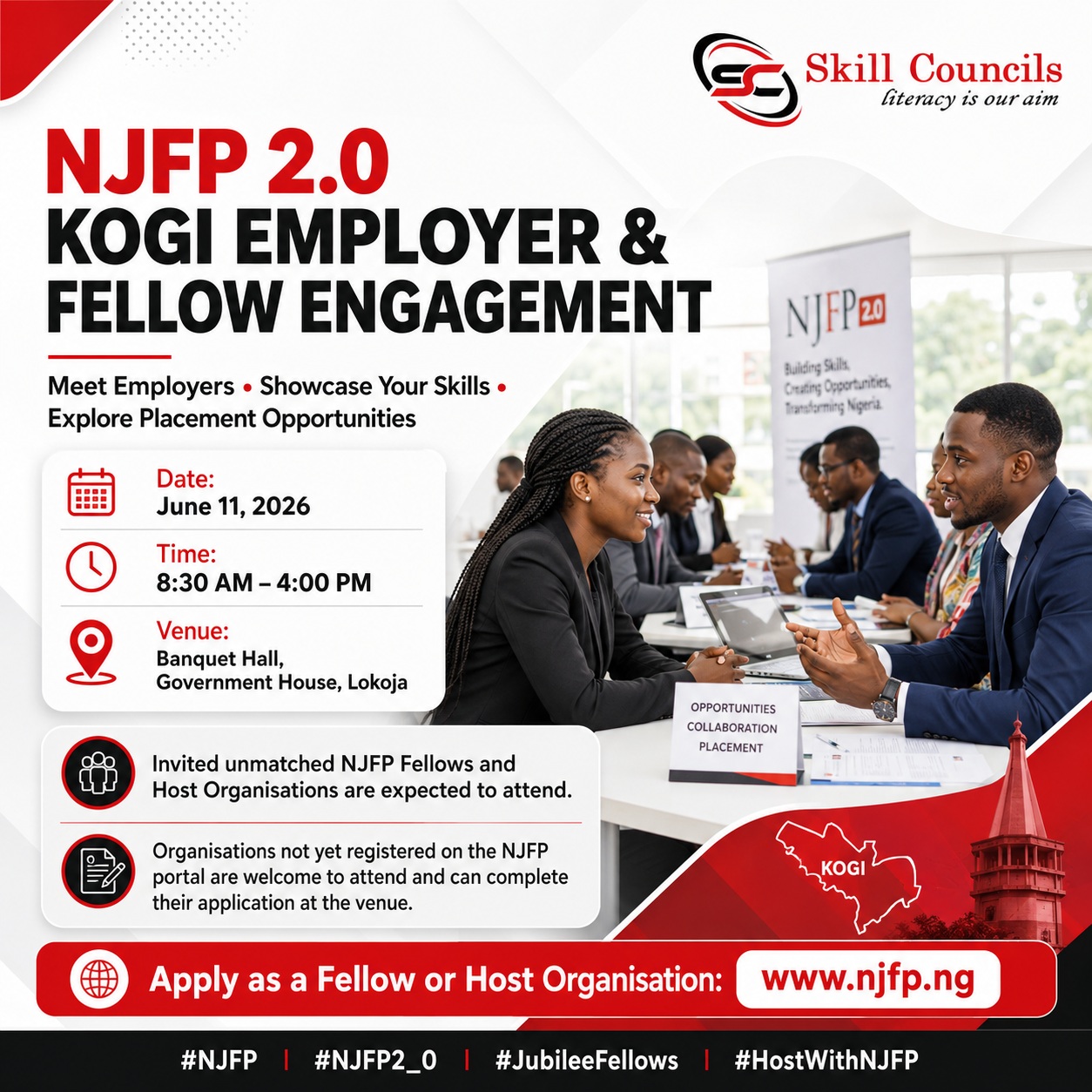
NJFP 2.0 Kogi Employer & Fellow Engagement 2026: Eligibility, Stipend, Employers & Funding Details
NJFP 2.0 Kogi Employer & Fellow Engagement 2026: Eligibility, Stipend, Host Organisations, Funding and Placement Opportunities
The NJFP 2.0 Kogi Employer & Fellow Engagement 2026 connects eligible Nigeria Jubilee Fellows with host organisations for interviews, matching and placement opportunities in Lokoja. Check eligibility, authorities, stipend, employer requirements, funding and impact.
Focus Keywords
NJFP 2.0 Kogi, Nigeria Jubilee Fellows Programme, NJFP Kogi Employer Fellow Engagement, NJFP eligibility 2026, NJFP stipend, NJFP host organisation, youth employment Nigeria, graduate placement Nigeria, NJFP funding, NJFP Lokoja event
News Update
The Nigeria Jubilee Fellows Programme 2.0 has expanded its employer–fellow engagement drive to Kogi State, creating a direct platform for eligible fellows and host organisations to meet, interact, conduct interviews and explore placement opportunities.
The NJFP 2.0 Kogi Employer & Fellow Engagement is scheduled for June 11, 2026, from 8:30 AM to 4:00 PM at the Banquet Hall, Government House, Lokoja. The event is targeted at invited unmatched NJFP Fellows and Host Organisations, while organisations that are yet to complete registration on the NJFP portal are also encouraged to attend and complete their application at the venue.
The engagement forms part of NJFP 2.0’s wider objective of connecting high-potential Nigerian graduates with meaningful 12-month work placement opportunities across public and private sector organisations.
What is the Nigeria Jubilee Fellows Programme?
The Nigeria Jubilee Fellows Programme is a youth employability initiative led by the Federal Government of Nigeria, funded by the European Union and implemented by the United Nations Development Programme. The programme was designed to address unemployment and underemployment among young Nigerian graduates by linking them with workplace-based learning, mentorship, coaching and paid work placement opportunities.
NJFP 2.0 is the renewed and expanded phase of the programme. It focuses on strengthening employer participation, improving digital matching, expanding access to decent work, and building stronger pathways from education to employment and entrepreneurship.
Launch Date and Programme Timeline
The original Nigeria Jubilee Fellows Programme was publicly announced in August 2021, with applications opening in September 2021. The programme later entered implementation as a national graduate employment initiative, with a 12-month paid placement model for young graduates.
NJFP 2.0 was formally flagged off in October 2025 as a strengthened second phase focused on scaling youth employability, employer engagement and workforce transformation. The Kogi Employer & Fellow Engagement scheduled for June 11, 2026 is one of the state-level engagement activities under this second phase.
Key Authorities and Implementing Bodies
|
Role |
Authority / Institution |
|
Programme Owner |
Federal Government of Nigeria |
|
National Coordination |
Office of the Vice President |
|
Funding Partner |
European Union |
|
Implementing Partner |
United Nations Development Programme |
|
State-Level Engagement |
NJFP implementation structure with state stakeholders and host organisations |
|
Placement Partners |
Public sector bodies, private companies, SMEs, NGOs, development agencies and other approved host organisations |
Core Functions of NJFP 2.0
- Connect eligible Nigerian graduates with reputable host organisations for structured work placements.
- Provide 12-month paid fellowship opportunities to support transition from learning to earning.
- Offer mentorship, coaching, workplace readiness and professional development support.
- Help employers access pre-screened young talent without bearing the full cost of entry-level recruitment.
- Strengthen collaboration among government, private sector, development partners and youth employment actors.
- Support entrepreneurship pathways for fellows who may not move directly into salaried employment after placement.
- Build a national talent pipeline across sectors such as agriculture, digital technology, renewable energy, manufacturing, creative industries, finance, ICT and health services.
Eligibility for NJFP Fellows / Beneficiaries
Applicants are generally expected to meet the following requirements under NJFP 2.0:
|
Criteria |
Requirement |
|
Nationality |
Must be a Nigerian citizen |
|
Education |
Bachelor’s Degree or HND from any discipline |
|
Graduation Year |
Must have graduated not earlier than 2022 under NJFP 2.0 |
|
Academic Grade |
Minimum Second-Class Lower for degree holders or Upper Credit for HND holders |
|
Age Limit |
30 years or younger |
|
Employment Status |
Must not be currently employed |
|
NYSC Status |
Must have completed NYSC or hold a valid NYSC exemption certificate |
|
Professional Readiness |
Must show commitment to chosen career field and Nigeria’s socio-economic development |
|
Communication Skills |
Good written and verbal communication skills |
|
Documentation |
Degree/HND certificate, NYSC certificate or exemption, CV, NIN and BVN may be required |
Eligibility for Host Organisations / Employers
Host organisations are expected to provide credible workplace learning opportunities and comply with NJFP standards. Key requirements include:
|
Criteria |
Requirement |
|
Registration |
Up-to-date regulatory documentation, including CAC registration where applicable |
|
Expression of Interest |
Official letter showing understanding of NJFP objectives and commitment to accept fellows |
|
Role Clarity |
Clear description of available roles and placement requirements |
|
Mentorship |
Commitment to provide mentorship through experienced professionals |
|
Code of Conduct |
Agreement to follow NJFP guidelines and sign relevant code of conduct documents |
|
Inclusion Policy |
Non-discrimination policies covering gender, ethnicity, religion and disability status |
|
Safeguarding |
Policies against sexual harassment, exploitation and abuse |
|
Integrity |
No criminal record, conviction or affiliation with prohibited activities or organisations |
Benefits for Fellows
Fellows benefit from practical work exposure, structured mentoring, workplace discipline, professional networks, income support through monthly stipend, and opportunities for retention or transition into entrepreneurship after the placement period. NJFP 2.0 also strengthens post-fellowship support through alumni engagement and employability pathways.
Benefits for Employers
Employers gain access to a pool of pre-screened young Nigerian graduates, reduce entry-level talent incubation costs, strengthen organisational capacity and contribute to national workforce development. Host organisations also benefit from fresh perspectives, innovation, brand goodwill and participation in a national youth employment agenda.
Funding, Allocation and Utilisation
Publicly available funding data shows that NJFP has been supported by the European Union and implemented through UNDP in collaboration with the Federal Government of Nigeria. In 2022, a development cooperation agreement of €55 million was reported for job creation, with €44 million earmarked for NJFP-related support. The NJFP mid-term review also recorded project expenditure of about USD 14.95 million at the time of evaluation and reported that more than NGN 6.2 billion had been disbursed directly to fellows as stipends.
However, a full audited year-wise financial utilisation statement for each of the last five financial years is not publicly available in the open sources reviewed. Therefore, the table below summarises only verifiable public information.
|
Financial Year / Period |
Publicly Available Allocation or Funding Signal |
Publicly Available Utilisation / Progress |
|
2021–22 |
NJFP announced and applications opened; EU and UNDP support confirmed |
Programme framework and application process initiated |
|
2022–23 |
Jubilee Fellows Fund launched to mobilise resources beyond traditional public finance |
Implementation and placement systems expanded |
|
2023–24 |
EU-funded implementation continued |
Fellows placed across host organisations; tech-focused placement partnerships expanded |
|
2024–25 |
Project continued under EU/UNDP support |
Mid-term review recorded USD 14.95 million project expenditure and NGN 6.2 billion stipend disbursement to fellows |
|
2025–26 |
NJFP 2.0 flagged off; Federal Government targeted at least 20,000 jobs annually and minimum 24,000 fellows over 10 months with EU support |
State-level employer–fellow engagements such as Kogi are being used to improve matching, interviews and placement opportunities |
Impact Analysis
NJFP 2.0 is significant because it addresses one of the biggest gaps in graduate employability: the transition from qualification to practical workplace experience. By combining paid placement, mentorship, employer engagement and sector-specific matching, the scheme supports both sides of the labour market.
For fellows, the programme reduces barriers created by lack of experience. For employers, it lowers the cost and risk of identifying entry-level talent. For the government and development partners, it offers a scalable model for reducing youth unemployment, improving productivity and supporting inclusive growth.
The Kogi engagement is especially important because it brings the national programme closer to state-level labour markets. It allows local employers to identify talent directly and gives unmatched fellows an opportunity to present their skills, attend interviews and secure placement pathways.
R&D / Policy Insight
From a policy and workforce-development perspective, NJFP 2.0 shows a shift from classroom-based employability support to demand-led placement systems. The programme’s focus on host organisation needs, digital matching, mentorship, stipend tracking and alumni support makes it a useful model for countries trying to link graduate education with employment outcomes.
For stronger long-term impact, the programme may need more transparent annual financial reporting, deeper private-sector co-financing, stronger post-placement tracking, and greater support for fellows placed far from their home locations. These improvements can help NJFP evolve from a fellowship scheme into a sustainable national workforce transition platform.
Conclusion
The NJFP 2.0 Kogi Employer & Fellow Engagement 2026 is more than a recruitment event. It is a targeted workforce development intervention that connects young graduates with employers, strengthens placement opportunities and supports Nigeria’s broader youth employment agenda.
Eligible fellows and host organisations should use the Kogi engagement to complete registration, attend interviews, showcase skills and explore practical placement opportunities under the Nigeria Jubilee Fellows Programme 2.0.
NJFP 2.0, Nigeria Jubilee Fellows Programme, Kogi Jobs, Lokoja, Youth Employment, Graduate Employability, Skill Development, Workforce Development, Employer Engagement, Public Private Partnership, UNDP Nigeria, European Union, Nigeria Jobs, Fellowship Programme, SkillCouncils
View News Document
Recent Blogs




 in India Structure, Role, and Opportunities for Stakeholders.jpg)


.jpg)

.jpg)
