

News Details
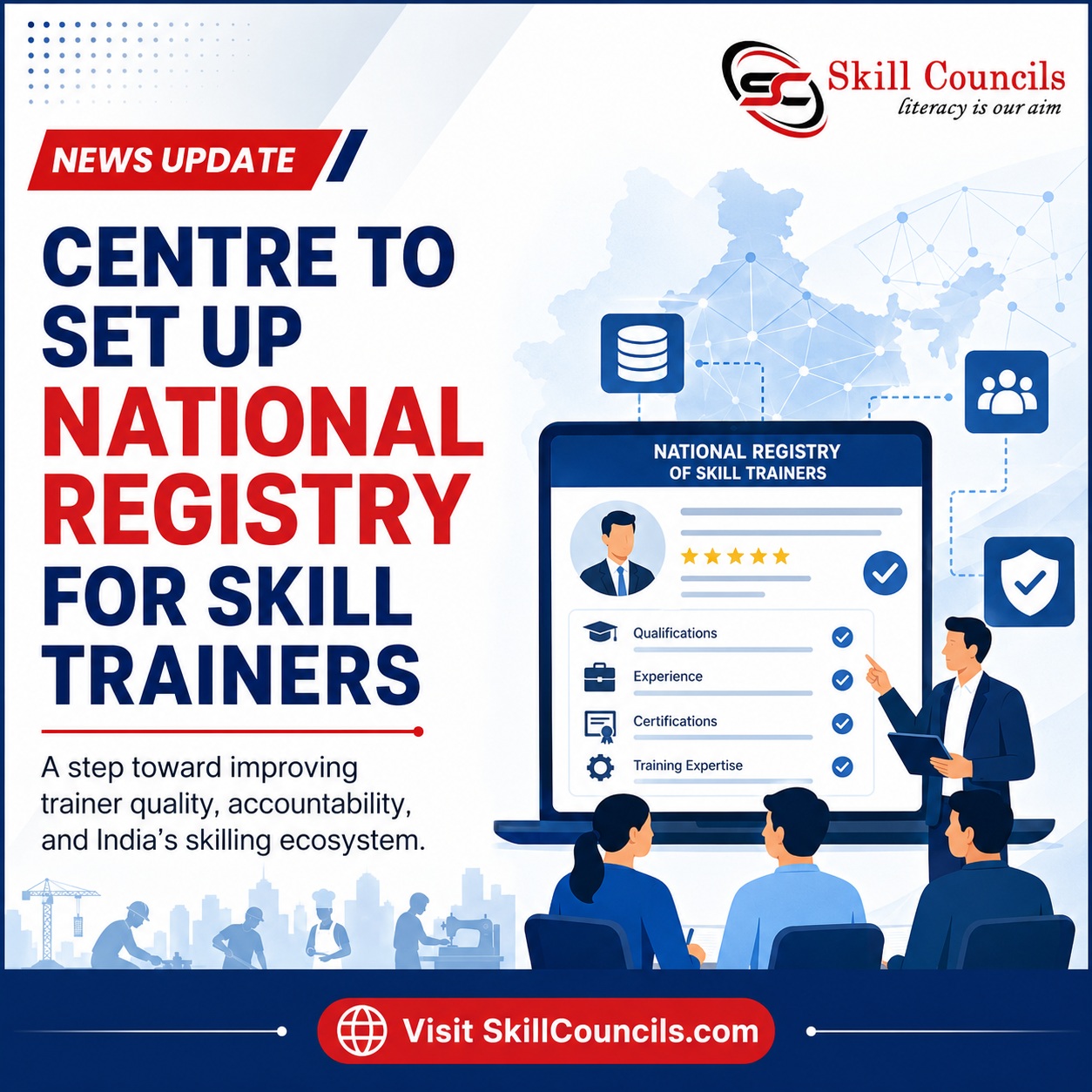
Centre to Set Up National Skill Instructor Registry to Improve Trainer Quality and Deployment Across India
Centre Plans National Registry for Skill Trainers to Strengthen India’s Skilling Ecosystem
The Ministry of Skill Development and Entrepreneurship is planning a national Skill Instructor Registry to create a central database of qualified trainers, improve training quality, and support India’s vocational education ecosystem.
By SkillCouncils News Desk
The Centre is planning to establish a national-level Skill Instructor Registry (SIR) to create a centralised database of skill trainers working across various skilling programmes in India. The proposed initiative is expected to improve the availability, deployment, transparency, and quality monitoring of trainers in the country’s vocational training ecosystem.
According to media reports, the Ministry of Skill Development and Entrepreneurship is working on the registry as part of a broader effort to strengthen the skilling framework and address gaps in the availability of qualified instructors. The registry is expected to act as a structured digital platform where trainers can be identified, verified, and deployed more efficiently across different schemes, sectors, and training institutions.
Why the Skill Instructor Registry Matters
India’s skill development ecosystem depends heavily on the quality of trainers. While infrastructure, curriculum, assessment systems, and industry partnerships are important, trainers remain the most critical link between training standards and learner outcomes.
A national registry of trainers can help bring greater visibility to the available pool of instructors across sectors. It can also support better coordination between government bodies, training partners, sector skill councils, institutions, and employers.
The proposed Skill Instructor Registry may help address some of the long-standing challenges in the skilling ecosystem, including shortage of qualified trainers, uneven trainer availability across regions, difficulty in identifying verified instructors, and lack of standardised trainer data at the national level.
Central Database for Trainers
The registry is expected to function as a central database of skill instructors across skilling programmes. Each registered trainer may be issued a unique registration number, helping authorities and institutions track trainer credentials, experience, deployment history, and areas of expertise.
Such a system can support better planning, especially in sectors where demand for skilled manpower is rising and training capacity needs to be expanded quickly. A verified trainer database can also help reduce duplication, improve accountability, and make trainer mobilisation faster for new training projects.
Boost to Training Quality and Accountability
The proposed registry is likely to play an important role in improving quality assurance in vocational training. By maintaining verified information on trainers, the system can help ensure that training programmes are delivered by qualified and competent professionals.
For training providers, the registry may simplify the process of finding certified and experienced trainers. For government departments and implementing agencies, it can offer a more transparent mechanism to assess trainer availability and suitability.
For learners, better trainer quality can directly improve classroom delivery, practical training, and overall learning outcomes.
Alignment with India’s Skill Development Goals
The initiative comes at a time when India is focusing on improving employability, expanding industry-linked skilling, and building a future-ready workforce. A strong trainer ecosystem is essential for achieving these goals, particularly in emerging sectors such as artificial intelligence, electronics, green jobs, healthcare, logistics, manufacturing, construction, and advanced technical trades.
The Ministry of Skill Development and Entrepreneurship plays a central role in coordinating skill development efforts across the country, strengthening vocational training systems, and addressing the gap between demand and supply of skilled manpower. The proposed registry is expected to support this mandate by strengthening the human resource backbone of the training ecosystem.
Possible Benefits for the Skilling Ecosystem
The Skill Instructor Registry could benefit multiple stakeholders across the skill development value chain.
For trainers, it may provide formal recognition, better visibility, and improved opportunities for deployment across government and industry-linked programmes. For training providers, it may create access to a verified pool of instructors. For policymakers, it can support data-driven decisions on trainer capacity, sectoral demand, and regional gaps.
The registry may also support future initiatives related to trainer certification, upskilling, reskilling, performance tracking, and quality benchmarking.
Implementation Details Awaited
While the proposal signals an important step toward strengthening trainer management in India, detailed guidelines are still awaited. Key aspects such as registration process, eligibility criteria, verification mechanism, integration with existing skill platforms, renewal requirements, and data governance framework will be important for effective implementation.
Stakeholders across the skill development ecosystem, including training partners, sector skill councils, assessment agencies, institutions, and independent trainers, are expected to closely watch the rollout of the registry.
SkillCouncils View
The proposed national Skill Instructor Registry can become a major reform in India’s skilling ecosystem if implemented with transparency, sector-wise mapping, and strong quality standards. Trainer availability and quality are central to the success of any skill development programme. A credible national registry can help India build a more accountable, efficient, and outcome-driven vocational training system.
As India works toward building a skilled and employable workforce, investing in trainer quality is not just an administrative reform—it is a foundational requirement for the future of work.
Skill Instructor Registry, Skill Trainers India, Skill Development, MSDE, Vocational Training, Skill India, Trainer Certification, Training Quality, SkillCouncils, Workforce Development
View News Document
Recent Blogs



 in India Structure, Role, and Opportunities for Stakeholders.jpg)

.jpg)


.jpg)
