

News Details
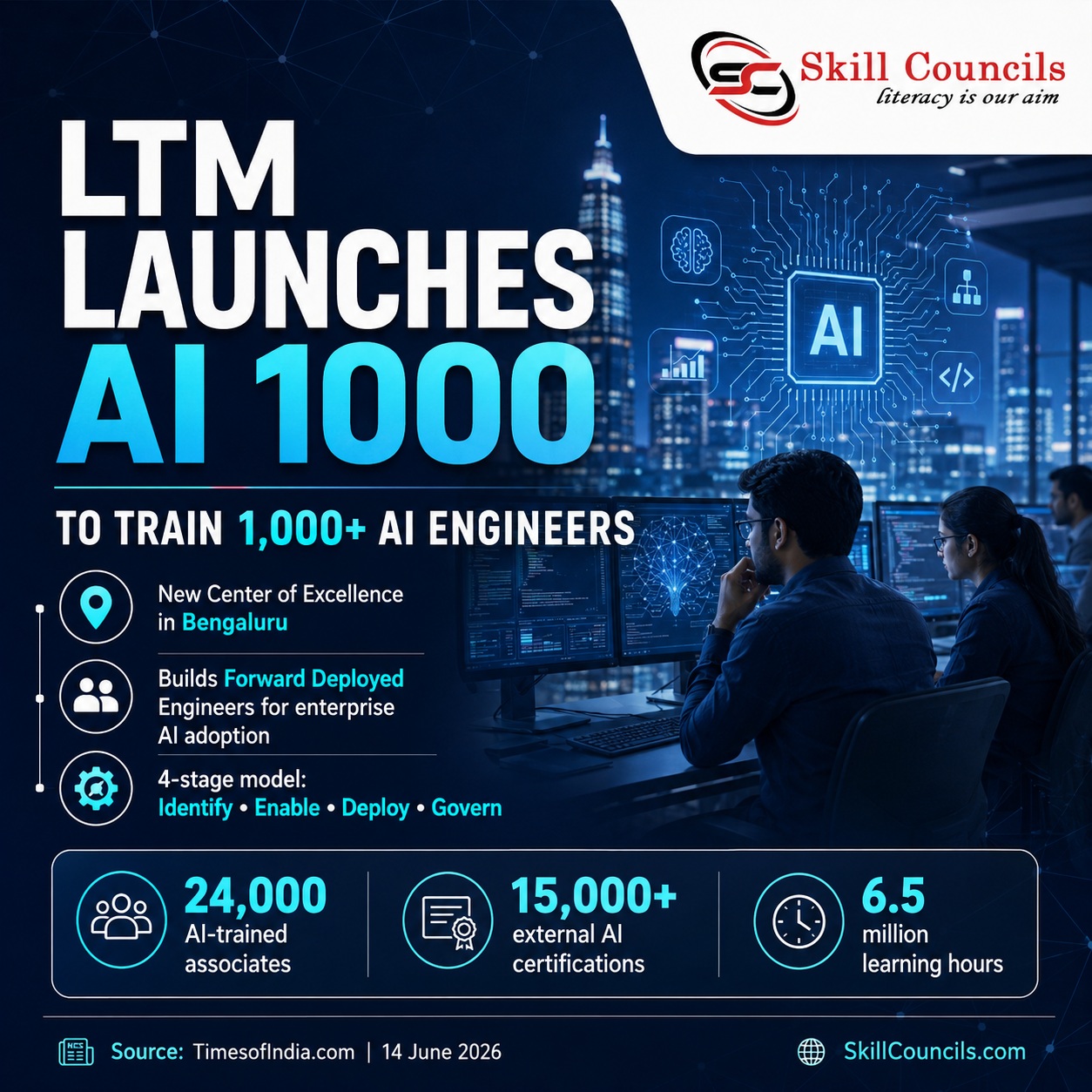
LTM Launches AI 1000 to Train Over 1,000 AI-Certified Engineers for Enterprise AI Adoption
LTM Launches AI 1000 to Train 1,000+ AI Engineers Through Bengaluru Centre of Excellence
LTM has launched AI 1000, a workforce transformation initiative aimed at training 1,000+ AI-certified engineers, including Forward Deployed Engineers, through its new Bengaluru Centre of Excellence.
New Delhi, June 15, 2026: LTM has announced the launch of AI 1000, a major workforce transformation programme designed to build a future-ready pool of more than 1,000 AI-certified engineers. The initiative will be anchored by a newly established Centre of Excellence (CoE) in Bengaluru, with a focus on strengthening enterprise artificial intelligence adoption, deployment, and measurable business impact.
The programme aims to develop the next generation of Forward Deployed Engineers (FDEs) — a fast-emerging role in the AI ecosystem that combines deep technical expertise with domain understanding and business problem-solving capabilities. These engineers are expected to work closely with enterprises to implement AI solutions, integrate large language models and domain-specific models, and help organisations convert AI investments into tangible outcomes.
Building AI Talent for Enterprise Transformation
As organisations across sectors accelerate their adoption of artificial intelligence, the demand for professionals who can bridge technology, business, and implementation has grown significantly. LTM’s AI 1000 initiative is positioned to address this talent gap by creating structured pathways for engineers to acquire AI-native skills and apply them in real-world enterprise environments.
The programme will train engineers in areas linked to large language models (LLMs), small or domain-specific language models (SLMs), applied AI platforms, business use cases, deployment frameworks, and governance-led implementation. The focus is not only on learning AI tools but also on using them to deliver measurable productivity, efficiency, and business value.
Four-Stage Talent Development Model
AI 1000 will follow a four-stage talent model: Identify, Enable, Deploy, and Govern.
Under the Identify stage, LTM will use a proprietary AI Readiness Index to assess and identify high-potential engineers who can be trained for advanced AI roles.
The Enable stage will focus on curated learning journeys, hands-on training, hackathons, and real-world use cases to validate practical AI capabilities.
In the Deploy stage, qualified engineers will be placed into AI-driven enterprise programmes, where they can contribute to actual client and business transformation projects.
The final stage, Govern, will track engineer performance, capture insights, monitor outcomes, and feed learnings back into the talent development ecosystem. This creates a continuous capability-building cycle rather than a one-time training programme.
Focus on Forward Deployed Engineers
The Forward Deployed Engineer role is increasingly gaining relevance as companies move from AI experimentation to scaled AI implementation. Unlike conventional technical roles, FDEs are expected to work at the intersection of engineering, product deployment, client requirements, and business outcomes.
These professionals help organisations identify use cases, customise AI solutions, deploy models, monitor outcomes, and ensure that AI systems are aligned with operational and commercial objectives. With AI 1000, LTM aims to create a structured pipeline of such professionals who can support enterprise AI adoption at scale.
Leadership View
Venu Lambu, CEO and Managing Director of LTM, said the role of technology engineers is rapidly evolving as AI becomes central to business transformation. He noted that AI 1000 has been developed to improve workforce productivity and create tangible business outcomes.
According to the company, the AI 1000 Centre of Excellence will help build structured pathways that combine technical excellence with domain expertise, preparing engineering talent for the future of work.
Strong Existing AI Learning Foundation
LTM has already built a significant internal base for AI learning and certification. The company has reported 6.5 million learning hours, 84% learning penetration, more than 15,000 external AI certifications, and 24,000 AI-trained associates.
AI 1000 formalises these efforts into a more structured and evidence-based programme, with defined role pathways, measurable milestones, and governed deployment frameworks.
The company has also indicated that the success of the programme will not be measured only by the number of employees trained, but by the business outcomes delivered by those engineers.
Why This Matters for India’s AI Workforce
The launch of AI 1000 comes at a time when India’s technology services sector is rapidly shifting towards AI-first delivery models. Enterprises are increasingly looking for skilled professionals who can move beyond theoretical knowledge and support practical implementation of AI solutions.
For India’s skilling and employment ecosystem, such initiatives highlight the growing importance of advanced digital skills, AI certification, workplace-based learning, and industry-led upskilling. Programmes like AI 1000 may also help set new benchmarks for how companies design structured training models for future-ready technology roles.
As AI becomes a key driver of business transformation, the demand for engineers with a combination of technical depth, domain expertise, and deployment capability is expected to rise sharply. LTM’s AI 1000 initiative reflects this shift and reinforces the growing role of corporate-led skill development in building India’s AI talent pipeline.
Key Highlights
- LTM has launched AI 1000 to train more than 1,000 AI-certified engineers.
- The initiative will be anchored by a new Centre of Excellence in Bengaluru.
- The programme will focus on building Forward Deployed Engineers for enterprise AI adoption.
- AI 1000 follows a four-stage model: Identify, Enable, Deploy, and Govern.
- LTM has already recorded 6.5 million learning hours and 24,000 AI-trained associates.
- The programme will focus on measurable business outcomes rather than training numbers alone.
Artificial Intelligence, Skill Development, Workforce Transformation, Technology Training
AI Training, AI Engineers, Skill Development, Future of Work, Digital Skills, Enterprise AI, Workforce Transformation, Bengaluru Tech, AI Certification
View News Document
Recent Blogs


 in India Structure, Role, and Opportunities for Stakeholders.jpg)


.jpg)

.jpg)
