

News Details
37th Skill Development Programme on Pharmacovigilance 2026 by IPC Ghaziabad: Dates, Fee, Eligibility, Benefits and Impact
37th Skill Development Programme on Pharmacovigilance 2026: Applications Invited by NCC-PvPI, Indian Pharmacopoeia Commission
NCC-PvPI, Indian Pharmacopoeia Commission, has invited applications for the 37th Skill Development Programme on Pharmacovigilance from 15–19 June 2026 at IPC Ghaziabad. Check eligibility, fee, functions, authorities, policy background and impact.
Focus Keywords: Pharmacovigilance Skill Development Programme 2026, PvPI training 2026, Indian Pharmacopoeia Commission training, NCC-PvPI Ghaziabad, drug safety training India, healthcare skill development, pharmacovigilance course India
News Update
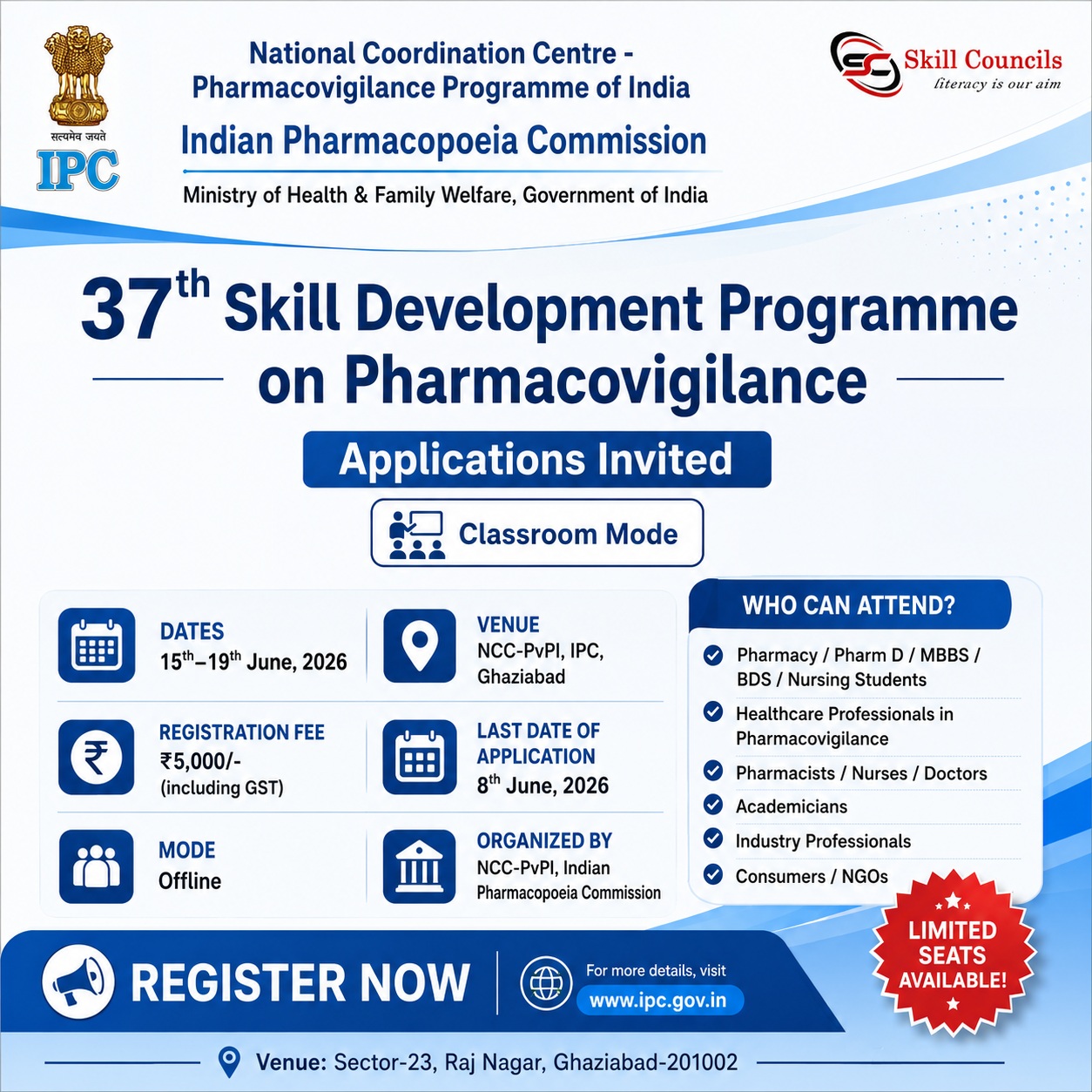
The National Coordination Centre – Pharmacovigilance Programme of India, Indian Pharmacopoeia Commission, has invited applications for the 37th Skill Development Programme on Pharmacovigilance, scheduled from 15 June to 19 June 2026 in classroom mode at NCC-PvPI, IPC, Ghaziabad.
The five-day offline programme is designed to build practical knowledge in pharmacovigilance, adverse drug reaction reporting, drug safety monitoring, patient safety systems, and regulatory reporting mechanisms. The programme is important for pharmacy students, healthcare professionals, doctors, nurses, academicians, industry professionals, public health stakeholders and NGOs working in healthcare and medicine safety.
Key Highlights
|
Particular |
Details |
|
Programme Name |
37th Skill Development Programme on Pharmacovigilance |
|
Organising Authority |
National Coordination Centre – Pharmacovigilance Programme of India, Indian Pharmacopoeia Commission |
|
Ministry |
Ministry of Health & Family Welfare, Government of India |
|
Programme Dates |
15–19 June 2026 |
|
Mode |
Offline / Classroom Mode |
|
Venue |
NCC-PvPI, IPC, Ghaziabad – 201002 |
|
Registration Fee |
₹5,000 including GST |
|
Last Date of Application |
8 June 2026 |
|
Sector |
Healthcare, Pharmacy, Clinical Research, Public Health, Drug Safety |
|
Programme Type |
Government capacity-building and skill development programme |
Policy Background: What is PvPI?
The Pharmacovigilance Programme of India is India’s national drug safety monitoring programme. It supports the collection, analysis and assessment of adverse drug reactions and drug-related safety information from across the country. The programme plays a critical role in strengthening patient safety, supporting evidence-based regulatory decisions, improving public confidence in medicines, and promoting rational use of drugs.
The programme is coordinated by the Indian Pharmacopoeia Commission through the National Coordination Centre – Pharmacovigilance Programme of India. IPC functions under the Ministry of Health & Family Welfare, Government of India, and supports national activities related to medicine quality standards, reference substances, pharmacovigilance, training and public health safety.
Launch Date and Institutional Timeline
|
Year / Date |
Development |
|
July 2010 |
Pharmacovigilance Programme of India was launched by the Ministry of Health & Family Welfare. |
|
15 April 2011 |
The National Coordination Centre of PvPI was shifted from AIIMS, New Delhi to Indian Pharmacopoeia Commission, Ghaziabad. |
|
18 July 2017 |
IPC was recognised as a WHO Collaborating Centre for Pharmacovigilance in Public Health Programmes and Regulatory Services. |
|
15–19 June 2026 |
37th Skill Development Programme on Pharmacovigilance scheduled at NCC-PvPI, IPC, Ghaziabad. |
Main Functions of PvPI
The Pharmacovigilance Programme of India works as a national patient safety and drug safety system. Its major functions include:
- Collection, collation and analysis of adverse drug reaction reports.
- Identification and assessment of new drug safety signals.
- Support to regulatory agencies for evidence-based decisions.
- Generation of drug safety information for healthcare professionals and the public.
- Capacity building of healthcare professionals, institutions and stakeholders.
- Promotion of rational and safe use of medicines.
- Coordination with Adverse Drug Monitoring Centres across India.
- Training, technical support and awareness building in pharmacovigilance.
- Collaboration with national and international public health and regulatory bodies.
- Strengthening India’s contribution to global drug safety databases.
Authorities and Implementation Structure
|
Authority / Body |
Role |
|
Ministry of Health & Family Welfare, Government of India |
Parent ministry and policy authority |
|
Indian Pharmacopoeia Commission |
National coordination and implementation institution |
|
NCC-PvPI |
Operational coordination centre for PvPI activities |
|
CDSCO |
National drug regulatory authority supported by PvPI recommendations |
|
Adverse Drug Monitoring Centres |
Collection and reporting of adverse drug reactions from healthcare institutions |
|
Healthcare Institutions and Medical Colleges |
Reporting, awareness, training and institutional participation |
|
WHO Collaborating Centre Functions |
International collaboration, technical cooperation and public health pharmacovigilance support |
Eligibility: Who Can Attend?
As per the programme communication, the following categories can attend:
- Pharmacy, Pharm D, MBBS, BDS and Nursing students
- Healthcare professionals working in pharmacovigilance
- Pharmacists, nurses and doctors
- Academicians
- Industry professionals
- Consumers and NGOs
Beneficiaries of the Programme
This programme is not a cash-transfer or subsidy scheme. It is a skill development and capacity-building programme for strengthening human resources in the healthcare and drug safety ecosystem.
Direct Beneficiaries
- Students from pharmacy, medical, dental and nursing backgrounds
- Healthcare professionals
- Pharmacovigilance professionals
- Pharmacists, doctors and nurses
- Faculty members and academicians
- Clinical research and regulatory affairs professionals
- Industry professionals from pharmaceutical and healthcare organisations
- NGOs and consumer safety groups working in public health
Indirect Beneficiaries
- Patients and medicine users
- Hospitals and healthcare institutions
- Pharmaceutical and clinical research organisations
- Regulators and public health authorities
- Medical colleges and training institutions
- Public health programmes requiring drug safety monitoring
Eligibility and Benefits for Employers
There is no separate employer subsidy, reimbursement or incentive mentioned for the 37th Skill Development Programme. However, employers can benefit by nominating staff members for capacity building.
Suitable Employers / Institutions
- Hospitals and healthcare chains
- Medical colleges and teaching hospitals
- Pharmacy colleges
- Pharmaceutical companies
- Clinical research organisations
- Contract research organisations
- Marketing Authorisation Holders
- Public health programmes
- Regulatory affairs teams
- NGOs working in medicine safety, patient safety and healthcare awareness
Employer Benefits
- Improved in-house pharmacovigilance capability
- Better adverse drug reaction reporting compliance
- Stronger patient safety culture
- Improved regulatory awareness
- Skilled workforce for drug safety and clinical research roles
- Support for quality and accreditation-related healthcare processes
- Better preparedness for pharmacovigilance audits and regulatory expectations
Fund Allocation and Utilisation: Last Five Financial Years
No separate public allocation has been found for the individual 37th Skill Development Programme on Pharmacovigilance. The official programme notice mentions a registration fee of ₹5,000 including GST, but does not disclose a separate training budget or course-wise expenditure.
For policy reference, the parent institution, Indian Pharmacopoeia Commission, receives budgetary support under government grant heads. The following table should be treated as institutional budget context, not a dedicated budget for this specific training programme.
Indian Pharmacopoeia Commission – Grants-in-Aid Salary Budget Context
|
Financial Year |
Amount / Estimate |
Budget Head Context |
Editorial Interpretation |
|
2021–22 |
₹5.32 crore actual |
Grants-in-Aid Salaries – IPC |
Institutional salary support for IPC |
|
2022–23 |
₹5.87 crore actual |
Grants-in-Aid Salaries – IPC |
Institutional salary support for IPC |
|
2023–24 |
₹7.00 crore actual |
Grants-in-Aid Salaries – IPC |
Institutional salary support for IPC |
|
2024–25 |
₹8.00 crore revised estimate |
Grants-in-Aid Salaries – IPC |
Revised institutional salary estimate |
|
2025–26 |
₹9.00 crore budget estimate |
Grants-in-Aid Salaries – IPC |
Budget estimate for institutional salary support |
Important Note: These figures are not course-wise expenditure figures. They represent publicly available institutional budget lines for IPC under Grants-in-Aid Salaries. Course-level expenditure and utilisation for the 37th Skill Development Programme have not been separately disclosed in the official notice.
Utilisation and Impact Indicators
Available public records show that PvPI has expanded its national role in medicine safety monitoring. In recent performance reporting, PvPI has reported expansion of Adverse Drug Monitoring Centres, submission of Individual Case Safety Reports, drug safety alerts, product information updates and large-scale capacity-building activities.
Key public health and workforce impacts include:
- Strengthening India’s drug safety surveillance ecosystem
- Improving adverse drug reaction reporting from hospitals and healthcare institutions
- Supporting CDSCO and regulatory authorities with safety inputs
- Enhancing employability for pharmacy, clinical research and drug safety professionals
- Building trained manpower for healthcare, pharmaceutical and public health sectors
- Supporting India’s global contribution to pharmacovigilance databases
- Creating awareness among consumers, NGOs and public health stakeholders
R&D and Skill Development Analysis
Pharmacovigilance is a high-value area for India’s healthcare, pharmaceutical, clinical research and regulatory ecosystem. As India’s pharmaceutical industry grows, the demand for trained professionals in drug safety, medical coding, clinical research, regulatory affairs, patient safety and post-marketing surveillance is also increasing.
The 37th Skill Development Programme can help bridge this workforce gap by offering structured learning in pharmacovigilance practices. For students, it can create awareness about emerging career pathways. For professionals, it can improve reporting quality, compliance readiness and practical understanding of adverse event monitoring. For employers, it can contribute to safer healthcare systems and better regulatory alignment.
From an R&D perspective, stronger pharmacovigilance systems support evidence generation, benefit-risk assessment, signal detection and real-world safety monitoring. This makes such programmes important for healthcare innovation, public health research and patient safety governance.
Application Process
Interested and eligible candidates are required to register through the official registration form shared by the Indian Pharmacopoeia Commission / NCC-PvPI. Applicants should review the official instructions, submit the registration form before the deadline and pay the applicable registration fee as per official guidance.
Why This Programme Matters
The programme is important because pharmacovigilance is directly linked with patient safety and medicine safety. A strong pharmacovigilance ecosystem helps identify adverse drug reactions early, improves regulatory decision-making, supports rational use of medicines and enhances trust in healthcare systems.
For India’s skill development ecosystem, the programme also creates a specialised training opportunity in a growing healthcare domain where trained manpower is required by hospitals, pharmaceutical companies, clinical research organisations, medical colleges, public health programmes and regulatory support functions.
SEO FAQs
What is the 37th Skill Development Programme on Pharmacovigilance?
It is a five-day offline training programme organised by NCC-PvPI, Indian Pharmacopoeia Commission, to build knowledge and skills in pharmacovigilance, adverse drug reaction reporting and drug safety monitoring.
When will the programme be held?
The programme is scheduled from 15 June to 19 June 2026.
Where will the programme be conducted?
The programme will be conducted at NCC-PvPI, Indian Pharmacopoeia Commission, Ghaziabad – 201002.
What is the registration fee?
The registration fee is ₹5,000 including GST.
Who can attend the programme?
Pharmacy, Pharm D, MBBS, BDS and nursing students, healthcare professionals, pharmacists, nurses, doctors, academicians, industry professionals, consumers and NGOs can attend.
Is this a government scheme?
It is best described as a government-led capacity-building and skill development programme under the Pharmacovigilance Programme of India, coordinated by the Indian Pharmacopoeia Commission.
Is there any subsidy or stipend?
No subsidy, stipend or employer reimbursement has been mentioned in the official programme notice.
How does this programme help employers?
Employers can nominate staff to improve pharmacovigilance capability, adverse drug reaction reporting, compliance awareness and patient safety practices.
Pharmacovigilance, PvPI, Indian Pharmacopoeia Commission, NCC-PvPI, Skill Development, Healthcare Skills, Drug Safety, Patient Safety, Pharmacy Education, Clinical Research, Healthcare Training, Medical Education, Government Training Programme, Pharmacy Students, Healthcare Professionals, SkillCouncils
#Pharmacovigilance #PvPI #IndianPharmacopoeiaCommission #NCCPvPI #SkillDevelopment #HealthcareSkills #DrugSafety #PatientSafety #PharmacyEducation #ClinicalResearch #HealthcareTraining #MedicalEducation #PharmacyStudents #HealthcareProfessionals #SkillCouncils #GovernmentSchemes #PublicHealth
View News Document
Recent Blogs

 in India Structure, Role, and Opportunities for Stakeholders.jpg)

.jpg)
.jpg)
