

News Details
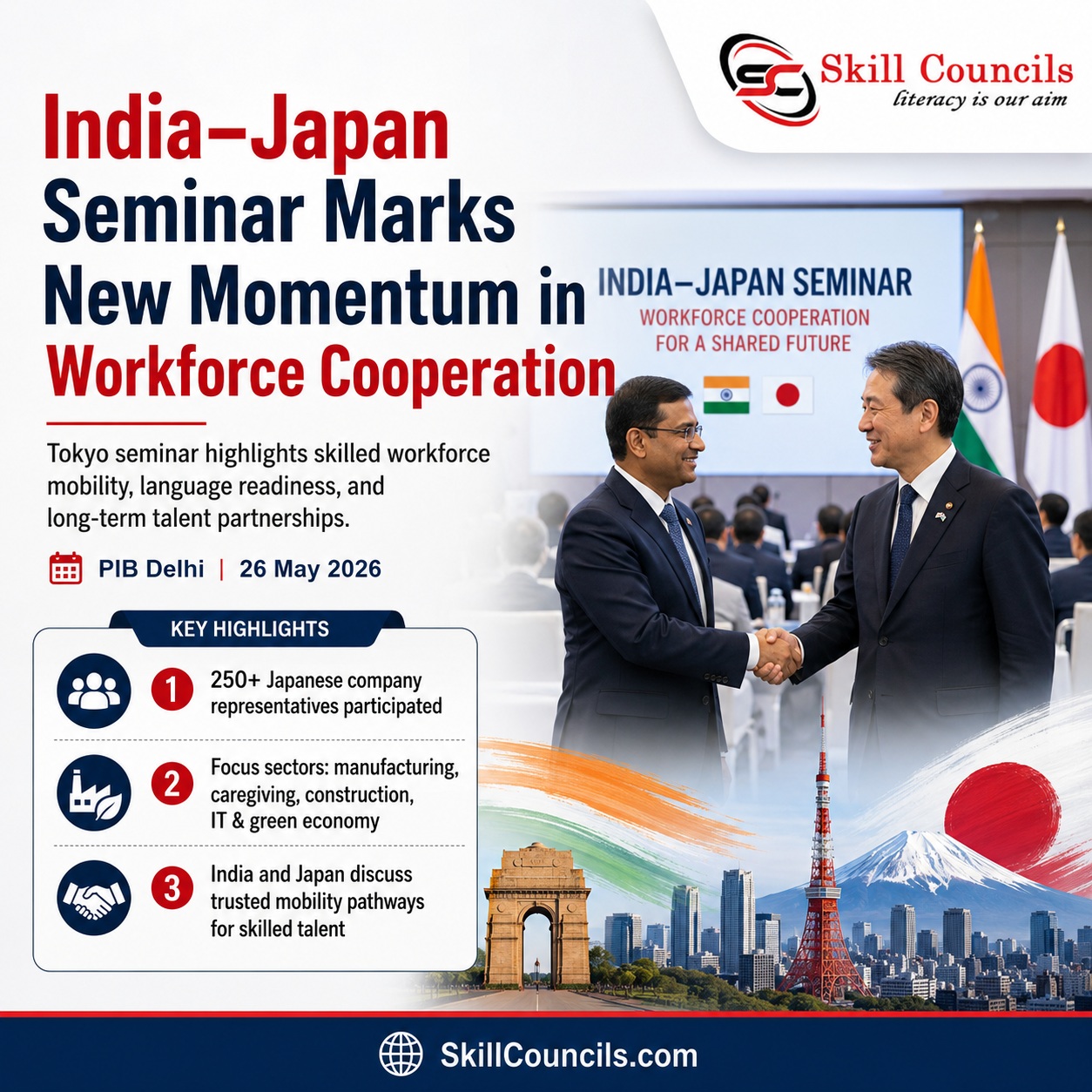
India–Japan Workforce Cooperation Gains Momentum as Tokyo Seminar Focuses on Skilled Mobility and Global Talent Pathways
India and Japan discussed long-term skilled workforce mobility, Japanese language readiness, ethical recruitment, sector-specific skilling and institutional cooperation at a joint seminar held in Tokyo.
Skill Development | International Workforce Mobility | Vocational Training | Employment
India–Japan Seminar Marks New Momentum in Workforce Cooperation and Skilled Mobility
Tokyo/New Delhi, 26 May 2026: India and Japan have taken another significant step toward strengthening long-term cooperation in skilled workforce mobility, human resource development and international employment pathways. A joint seminar held in Tokyo on 25 May 2026 brought together policymakers, industry leaders, academic institutions and workforce mobility stakeholders from both countries to discuss structured cooperation in preparing Indian talent for Japan’s evolving labour market needs.
The seminar was jointly organised by the Embassy of India in Japan and ASEAN ONE Co. Ltd., Japan. Ms. Vandana Gurnani, Secretary, Ministry of Labour & Employment, Government of India, delivered the keynote address and highlighted India’s growing role as a trusted partner in the global workforce ecosystem.
The event comes at a time when Japan is facing rising demand for skilled and trained manpower across several sectors, while India continues to expand its skilling, apprenticeship, digital employment and international labour mobility systems. The seminar focused on creating transparent, ethical and scalable pathways for Indian workers and professionals seeking global opportunities, particularly in Japan.
India Positioned as a Trusted Global Workforce Partner
In her keynote address, Ms. Gurnani underlined India’s demographic strength, expanding education and skilling ecosystem, and institutional reforms that support international labour mobility. She said India is committed to building transparent and ethical workforce mobility systems that can respond to the manpower requirements of global economies.
She highlighted that India’s workforce preparation is supported by a wide network of higher education institutions, Industrial Training Institutes, apprenticeship systems, digital skilling platforms and career services. These systems are increasingly being aligned with global employment requirements, including language training, skill recognition and sector-specific occupational standards.
The Secretary also referred to India’s existing international labour mobility framework, including the Ministry of External Affairs’ eMigrate platform, the National Career Service platform, Model Career Centres, and the wider skilling ecosystem supported by the Ministry of Skill Development & Entrepreneurship, State Governments and educational institutions.
Focus on Japanese Language, Skill Mapping and Ethical Recruitment
A major focus of the seminar was the need to prepare Indian candidates for Japan-specific employment pathways. Discussions highlighted the importance of Japanese language readiness, sector-specific training, testing infrastructure, occupational alignment, demand aggregation and ethical recruitment practices.
Both sides recognised that successful workforce mobility requires more than job placement. It requires structured preparation, language support, skill certification, employer engagement, cultural orientation and post-placement support.
The seminar also stressed the need to create stronger institutional collaboration between Indian skilling institutions and Japanese employers. This includes mapping Japanese industry demand with Indian training capacity, improving skill recognition frameworks and expanding testing centres in India.
Participation from Japanese Policymakers and Industry Leaders
The seminar witnessed participation from several prominent dignitaries from India and Japan. These included Members of the House of Representatives of Japan, senior government officials, representatives from Japanese ministries, financial institutions and industry bodies.
Among the notable participants were Mr. Yamashita, former Minister of Justice; Mr. Ino, State Minister of Economy, Trade and Industry; Mr. Nakamura, State Minister of Education, Culture, Sports, Science and Technology; Mr. Tadashi Maeda, Chairman, Japan Bank for International Cooperation; Mr. Kengo Otsuka, Deputy Director-General, Ministry of Foreign Affairs, Japan; and Ms. Nagma Mohamed Mallick, Ambassador of India to Japan.
Around 250 representatives of leading Japanese companies also participated in the seminar, including senior executives and human resource managers. Their participation reflected growing interest among Japanese employers in engaging with India’s skilled workforce ecosystem through structured and reliable channels.
Key Sectors Identified for India–Japan Workforce Cooperation
Participants identified strong potential for India–Japan cooperation across multiple employment-intensive sectors. These include:
|
Sector
|
Workforce Opportunity
|
|
Manufacturing
|
Skilled technicians, machine operators and production workforce
|
|
Caregiving
|
Trained care workers for Japan’s ageing population
|
|
Construction
|
Skilled trades, site workers and technical manpower
|
|
Automobile Maintenance
|
Service technicians and maintenance professionals
|
|
Hospitality
|
Trained hospitality and service-sector workforce
|
|
Agriculture
|
Skilled agricultural and farm-support workers
|
|
IT and Digital Services
|
Technology professionals and digital talent
|
|
Green Economy
|
Emerging roles in sustainability-linked sectors
|
The discussions also underlined the importance of digital public infrastructure and employment facilitation platforms in creating transparent, trackable and scalable mobility pathways.
Assam’s FLIGHT Initiative Highlighted
The seminar also highlighted the Assam Government’s Foreign Language Initiative for Global Talent (FLIGHT) as a state-led initiative to prepare candidates for international workforce opportunities. The initiative is particularly focused on Japan-oriented pathways, including language preparation and global employability readiness.
Special messages were received from the Japanese Prime Minister, the Chief Minister of Assam, Dr. Himanta Biswa Sarma, and the Director of IIT Guwahati. These messages outlined a medium- to long-term vision for proactive India–Japan personnel exchange and emphasised the growing role of Indian States and higher education institutions in preparing globally competitive talent.
Roadmap for Future Cooperation
As a way forward, both sides discussed several priority areas to deepen India–Japan workforce cooperation. These include expanding Japanese language and testing centres in India, strengthening collaboration between Japanese employers and Indian skilling institutions, improving visibility of workforce demand from Japan, promoting skill recognition and creating trusted mobility pathways.
The seminar also explored the possibility of a long-term Japan–India personnel exchange programme involving 50,000 people over the next 10 years. Mr. Toshiaki Nishikawa, Chairman & CEO, ASEAN GROUP Co. Ltd., reiterated the importance of people-to-people partnerships and expressed optimism about future workforce cooperation between the two countries.
SkillCouncils.com View
The Tokyo seminar reflects the growing importance of structured international workforce mobility in India’s skill development ecosystem. For Indian training providers, language institutes, assessment agencies, universities, State skill missions and placement organisations, Japan represents a major opportunity area.
However, the success of such mobility pathways will depend on strong coordination between employers, government agencies, skilling institutions and recruitment partners. Candidate preparation must go beyond basic training and include language proficiency, cultural readiness, occupation-specific standards, certification, ethical recruitment and post-placement support.
India’s demographic advantage can become a global workforce strength only when it is matched with quality training, credible certification and transparent mobility systems. The India–Japan cooperation model can become an important benchmark for future international skill partnerships
India Japan Workforce Cooperation, Skilled Workforce Mobility, Skill Development, Labour Mobility, Japan Jobs, Vocational Training, Global Talent, Japanese Language Training, International Employment, Skill India
View News Document
Recent Blogs


 in India Structure, Role, and Opportunities for Stakeholders.jpg)

.jpg)

.jpg)
