

Blog Details
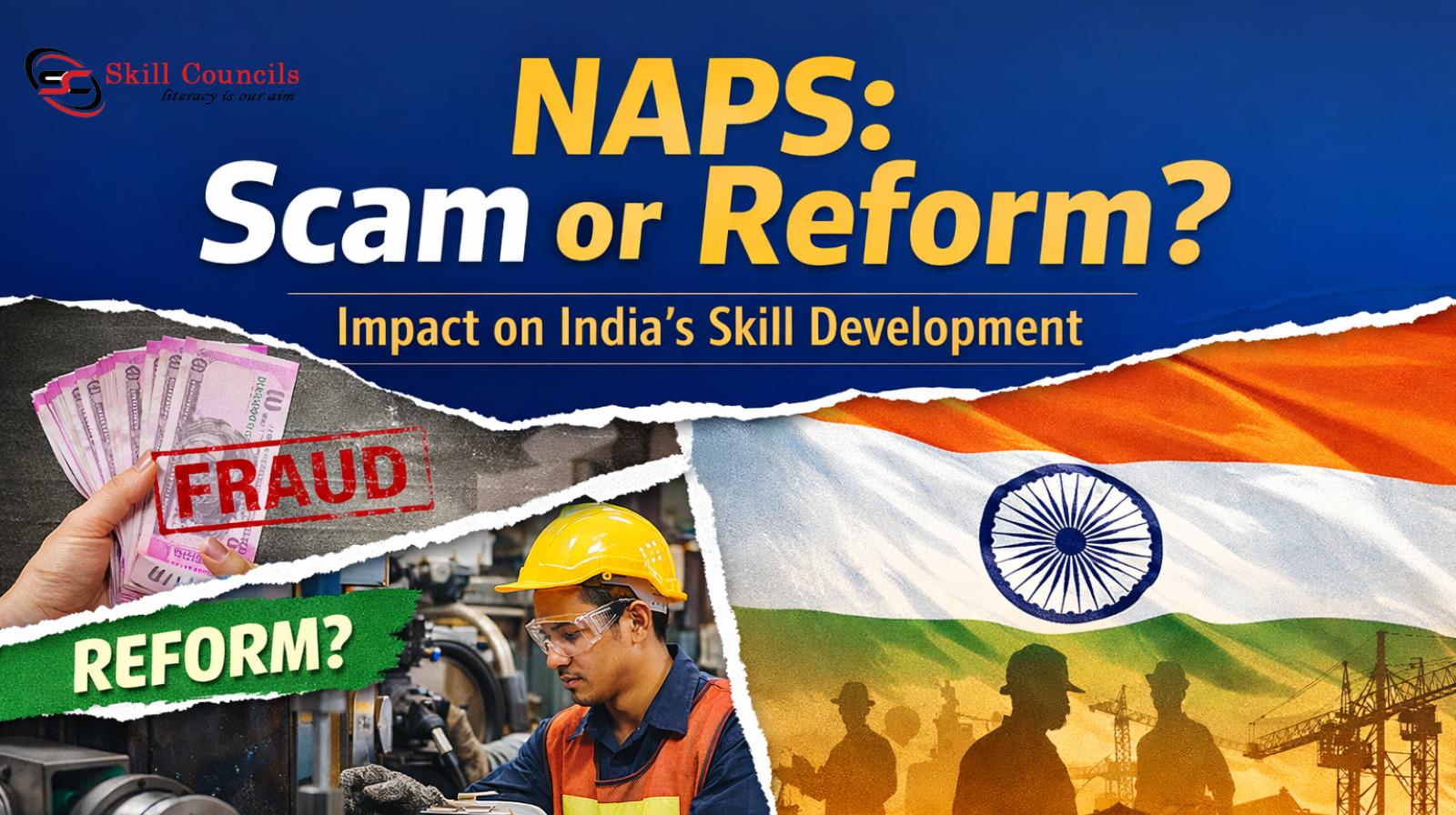
Is the National Apprenticeship Promotion Scheme (NAPS) Transforming India’s Skill Ecosystem or Facing Credibility Challenges?
Is the National Apprenticeship Promotion Scheme (NAPS) Transforming India’s Skill Ecosystem or Facing Credibility Challenges?
New Delhi, December 2025:
India’s skill development ecosystem has undergone rapid expansion over the past decade. With millions of young people entering the workforce every year, the country faces a critical challenge: bridging the gap between education and employability.
India’s skill development ecosystem has undergone rapid expansion over the past decade. With millions of young people entering the workforce every year, the country faces a critical challenge: bridging the gap between education and employability.
One of the government’s flagship initiatives aimed at addressing this gap is the National Apprenticeship Promotion Scheme (NAPS). Introduced to strengthen industry-linked training and real workplace learning, NAPS was designed to expand apprenticeship opportunities across India.
However, as the program grows in scale and visibility, a debate has emerged across policy circles, industry forums, and public discourse:
Is NAPS successfully transforming India’s workforce landscape, or are systemic weaknesses in the skill ecosystem limiting its true impact?
This article explores the structure, benefits, challenges, and future prospects of NAPS within India’s broader skill development mission.
Understanding the National Apprenticeship Promotion Scheme (NAPS)
The National Apprenticeship Promotion Scheme (NAPS) was launched in 2016 by the Ministry of Skill Development and Entrepreneurship (MSDE) to promote apprenticeship training across industries.
The scheme aims to encourage companies to hire apprentices and provide hands-on workplace training, enabling youth to acquire practical skills while earning a stipend.
Key Features of NAPS
The scheme provides financial and operational incentives to industries and training partners:
1. Stipend Support
The government reimburses 25% of the apprentice stipend (up to ₹1,500 per month) to employers.
The government reimburses 25% of the apprentice stipend (up to ₹1,500 per month) to employers.
2. Basic Training Cost Support
Up to ₹7,500 per apprentice is provided to cover basic training costs.
Up to ₹7,500 per apprentice is provided to cover basic training costs.
3. Industry-Led Skill Development
Training takes place within real workplaces rather than purely classroom environments.
Training takes place within real workplaces rather than purely classroom environments.
4. Digital Platform and Tracking
Apprenticeships are managed through the national apprenticeship portal to improve transparency and monitoring.
Apprenticeships are managed through the national apprenticeship portal to improve transparency and monitoring.
Since its launch, NAPS has reportedly engaged more than 25 lakh apprentices and expanded participation to over 40,000 establishments across India.
How NAPS Connects with India’s Skill Development Ecosystem
NAPS does not operate in isolation. It complements several large government skill initiatives, including:
- Pradhan Mantri Kaushal Vikas Yojana (PMKVY)
- Deen Dayal Upadhyaya Grameen Kaushalya Yojana (DDU-GKY)
Candidates trained under these schemes often transition into apprenticeships through NAPS, allowing them to move from training programs to real job environments.
This integration is intended to create a complete skill-to-employment pipeline.
Benefits of NAPS for Industry
1. Creation of a Skilled Workforce
For industries facing skill shortages, NAPS provides a steady pipeline of trained manpower. Companies can develop workers according to their own operational needs, reducing training and recruitment costs.
2. Reduced Hiring Risks
Hiring apprentices helps organizations assess candidates during training before offering permanent employment. This reduces attrition and hiring risks.
3. Industry–Academia Alignment
One of the major criticisms of India’s education system has been the gap between academic learning and industry needs.
NAPS allows companies to shape apprenticeship curricula, ensuring that training aligns with real workplace demands.
4. Expanding Talent Access in Rural India
By connecting training programs with industries, NAPS helps companies access talent from rural and semi-urban areas, supporting inclusive growth.
Benefits of NAPS for Youth and Job Seekers
1. Real Work Experience
Apprentices receive hands-on training within real companies, gaining practical skills that are often missing in academic education.
2. Earn While Learning
Participants receive stipends during training, allowing them to gain experience while earning income.
3. Improved Employability
Candidates with apprenticeship experience often have higher chances of employment compared to those with classroom-only training.
4. Career Entry Pathway
For youth completing secondary education, ITI courses, or skill programs, apprenticeships offer an important entry point into the formal workforce.
Key Challenges Facing the NAPS Program
Despite its positive framework, NAPS faces several structural and implementation challenges.
1. Underutilization of Targets
Early targets of enrolling millions of apprentices annually have not always been achieved. Many industries—especially MSMEs—remain hesitant to participate due to administrative complexity and compliance requirements.
2. Funding and Disbursement Delays
In some cases, allocated funds for apprenticeship promotion have remained underutilized due to bureaucratic delays and slow implementation mechanisms.
3. Weak Monitoring Across Skill Programs
Concerns have also been raised regarding data verification and placement reporting across certain skill development initiatives.
While these issues are not exclusive to NAPS, they highlight broader systemic challenges affecting India’s skill ecosystem.
4. Perception Challenges and Public Narratives
Social media discussions and online forums sometimes portray government skill schemes as ineffective due to instances of poor documentation or questionable placements.
However, most of these claims remain anecdotal rather than verified audit findings. Nevertheless, such narratives influence public perception and trust.
Economic Impact of Apprenticeship Programs
Apprenticeships globally are recognized as one of the most effective workforce development models.
Positive Economic Impact
If implemented effectively, NAPS can deliver major benefits:
- Increased workforce productivity
- Stronger industry competitiveness
- Reduced unemployment among youth
- Enhanced innovation through skilled labor
Risks of Weak Implementation
However, poor monitoring or implementation gaps can create challenges such as:
- Inefficient use of public funds
- Limited improvement in actual employment outcomes
- Declining public confidence in skill initiatives
Why Apprenticeships Are Critical for India’s Future
India is home to one of the world’s youngest populations, with millions entering the labor market every year.
Without strong skill development pathways, this demographic advantage could become a demographic challenge.
Programs like NAPS are designed to ensure that India’s youth are not just educated—but job-ready and industry-ready.
The Way Forward: Strengthening the Apprenticeship Ecosystem
Experts suggest several reforms to enhance the impact of apprenticeship programs:
1. Strengthening Data Transparency
Improving verification mechanisms and digital tracking of apprenticeships.
2. Increasing Industry Participation
Simplifying compliance procedures to encourage more MSMEs to join the scheme.
3. Integrating Skill Programs
Creating better coordination between skill schemes and apprenticeship placements.
4. Measuring Real Outcomes
Shifting focus from training numbers to employment outcomes and career progression.
Conclusion: Reform, Not Rejection
The National Apprenticeship Promotion Scheme is not inherently flawed. In fact, it represents one of the most promising workforce development frameworks in India.
However, its long-term success depends heavily on implementation quality, transparency, and continuous reform.
If strengthened with better monitoring, industry engagement, and outcome measurement, NAPS can play a crucial role in transforming India into a truly skilled nation.
The challenge now is not whether apprenticeship programs are needed—but how effectively they can be implemented to deliver real employment opportunities for India’s youth.
✔ For organizations, training providers, and policymakers, the focus must shift toward quality, accountability, and long-term career outcomes.
Only then can initiatives like NAPS fulfill their promise of bridging India’s skill gap and powering the country’s economic future.

Recent Blogs





 in India Structure, Role, and Opportunities for Stakeholders.jpg)


.jpg)


.jpg)
