

Blog Details
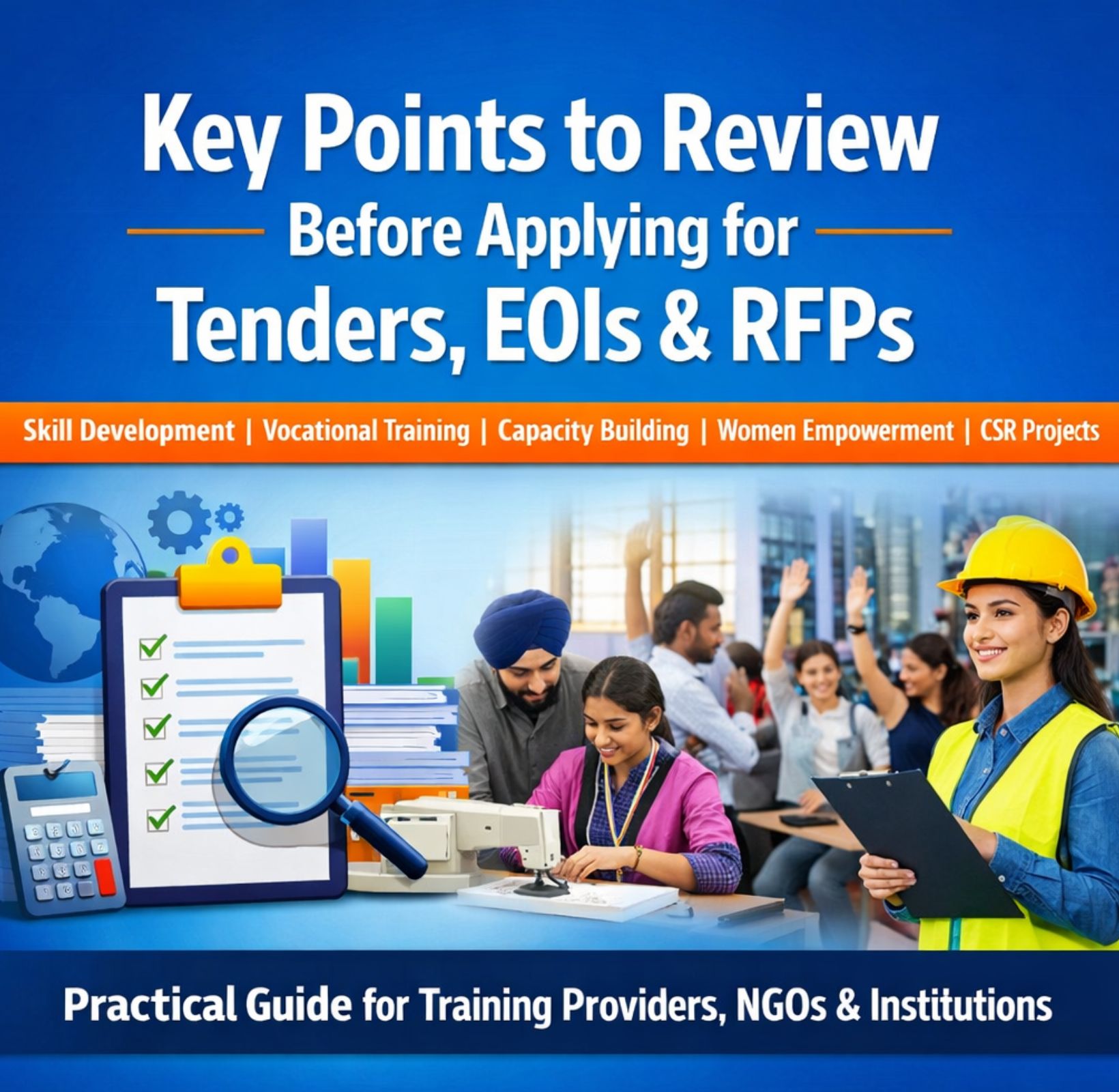
Key Points to Review Before Applying for Tenders, EOIs & RFPs in Skill Development, Vocational Training, Capacity Building, Women Empowerment & CSR Projects
Introduction
Government departments, public sector units, CSR foundations, and international development agencies regularly release Tenders, Requests for Proposals (RFPs), and Expressions of Interest (EOIs) for projects related to skill development, vocational training, capacity building, women empowerment, and livelihood promotion.
While many organizations focus on preparing proposals quickly, the real success begins with a thorough review of the tender document. A careful evaluation helps organizations determine eligibility, understand project expectations, assess financial viability, and avoid costly mistakes.
For training providers, NGOs, consultants, and institutions working in the skill ecosystem, reviewing tender documents strategically is essential before committing time, money, and resources.
This article outlines key points to review before participating in tenders, EOIs, or RFPs in the skill development and training sector.
1. Understanding the Scope of Work
The Scope of Work (SoW) defines what the implementing agency is expected to deliver.
Before preparing a proposal, carefully review:
- Target beneficiaries (youth, women, tribal communities, unemployed candidates, etc.)
- Training duration and course structure
- Expected outcomes (placements, certifications, entrepreneurship, etc.)
- Geographic coverage (district, state, or national)
- Infrastructure requirements
- Mobilization responsibilities
In skill development projects, the scope may include:
- Candidate mobilization
- Training delivery
- Certification
- Placement support
- Post-placement tracking
- Reporting and monitoring
Understanding these requirements early helps determine whether your organization has the capacity and infrastructure to deliver the project successfully.
2. Eligibility Criteria
Eligibility criteria determine who can apply for the project. Many organizations get disqualified simply because they overlook these conditions.
Common eligibility requirements include:
- Legal status (Company, Society, Trust, LLP, etc.)
- Minimum years of operational experience
- Relevant experience in training or skill development
- Annual turnover requirements
- Past project experience
- Presence in specific states or districts
Some tenders also require:
- Accreditation or affiliation with government schemes
- Certified trainers
- Existing training centers
- Sector-specific experience
Before proceeding with the proposal, ensure that all eligibility criteria are fully satisfied.
3. Technical Qualification Requirements
Most RFPs and tenders follow a two-stage evaluation process:
- Technical Evaluation
- Financial Evaluation
The technical proposal usually includes scoring criteria such as:
- Organizational experience
- Similar project experience
- Trainer qualifications
- Infrastructure availability
- Training methodology
- Monitoring and evaluation systems
Many government projects use the QCBS (Quality and Cost Based Selection) method, where technical scores determine eligibility for financial evaluation.
Organizations must carefully study the technical scoring matrix and align their proposal accordingly.
4. Financial Terms and Payment Structure
Financial conditions in skill development projects can vary significantly.
Important aspects to review include:
- Training cost per candidate
- Payment milestones
- Mobilization advance (if any)
- Outcome-based payments
- Placement-linked payments
- Reimbursement conditions
Many programs release funds in stages such as:
- Mobilization stage
- Training completion
- Certification
- Placement verification
- Post-placement retention
Understanding the cash flow implications is crucial before bidding.
5. Infrastructure and Resource Requirements
Some projects require existing infrastructure, while others allow new centers to be established.
Check for requirements such as:
- Training center size and facilities
- Lab equipment
- IT infrastructure
- Trainer-to-student ratio
- Hostel or residential training arrangements
- Safety and compliance requirements
In residential programs, requirements may also include:
- Accommodation
- Food facilities
- Security arrangements
- Health and sanitation standards
Organizations should ensure they can meet these standards before applying.
6. Documentation Requirements
Tender submissions often require extensive documentation.
Typical documents include:
- Registration certificates
- PAN and GST details
- Audited financial statements
- Income tax returns
- Experience certificates
- Work orders and completion certificates
- Bank details
- Affidavits and declarations
Missing or incorrect documentation is one of the most common reasons for bid rejection.
Maintaining a well-organized documentation repository can significantly streamline the submission process.
7. Compliance and Legal Conditions
Tender documents usually contain multiple compliance requirements.
Key legal aspects to review include:
- Contract conditions
- Penalty clauses
- Termination clauses
- Performance security requirements
- Blacklisting policies
- Arbitration provisions
Organizations should carefully assess the risk implications of these clauses before submitting a proposal.
8. Monitoring, Reporting, and Evaluation Requirements
Most skill development and capacity-building projects require detailed monitoring and reporting systems.
These may include:
- Daily attendance tracking
- Training progress reports
- Placement reports
- Candidate feedback
- Impact assessment
Some government schemes require integration with official portals or management information systems (MIS).
Organizations should evaluate whether they have the technology and manpower to manage reporting requirements.
9. Timeline and Implementation Schedule
Review the project timeline carefully.
Key elements include:
- Bid submission deadline
- Pre-bid meeting dates
- Project start date
- Training completion deadlines
- Reporting schedules
Short implementation timelines can create operational challenges if not planned properly.
10. Pre-Bid Clarifications
Many tenders provide an opportunity to submit pre-bid queries.
This is an important stage where bidders can:
- Seek clarification on ambiguous clauses
- Request modifications
- Understand evaluation criteria
- Clarify payment terms
Submitting well-structured pre-bid queries can significantly improve the clarity of the project requirements.
11. Partnership and Consortium Options
Some large projects allow bidders to participate through:
- Consortium arrangements
- Joint ventures
- Subcontracting
This can be useful when:
- One partner has technical expertise
- Another partner has infrastructure
- A third partner has local presence
Strategic partnerships can strengthen the overall proposal.
12. Alignment with Organizational Capacity
Finally, organizations should evaluate whether the project aligns with their strategic goals and operational capabilities.
Key questions to ask:
- Do we have sufficient trainers and staff?
- Can we mobilize the required number of candidates?
- Do we have the financial capacity to sustain the project?
- Does the project align with our long-term vision?
Participating in projects beyond organizational capacity can lead to financial losses and reputational risk.
Conclusion
The skill development ecosystem in India offers numerous opportunities through government schemes, CSR initiatives, and development projects.
However, success in this ecosystem depends not only on writing strong proposals but also on carefully reviewing and understanding tender documents before bidding.
By focusing on eligibility, technical requirements, financial terms, infrastructure needs, and compliance conditions, organizations can significantly improve their chances of winning and successfully implementing projects.
For training providers, NGOs, and consulting firms, developing a systematic tender review process is a critical step toward building a sustainable presence in the skill development sector.

Recent Blogs

 in India Structure, Role, and Opportunities for Stakeholders.jpg)

.jpg)
.jpg)
